Showing posts with label emcomm. Show all posts

26 April 2016

RFSM2400 and WinLink Winmor

Today I did some tests focused on the file transfer speed using two soundcard modems.

RFSM-2400 receiving test
RFSM-2400 is a freeware client program which can transfer files  over a radio channel, using MIL-STD-188-110A standard (300Hz to 3.3 kHz-2400 baud).

Winmor TNC, is a donationware program with a modulation scheme that resembles very close with the one used on PACTOR modems. The speed is bandwith related and is adaptive between 200 Hz and 2000 Hz.

RFSM 2400 can't be used to send files to internet servers but the Winmor is widely used with RMS Express to connect to various iGates around the world to send e-mails.

For tests I used a FT-991 connected

Winmor TNC receiving test

to RMS Trimode and to RFSM-8000 (can act as a server) and a IC-7300 connected to the RFSM-2400 and RMS Express with Winmor TNC.

I sent a jpeg file in size of 56.0 KB (57,344 bytes or 448.000 bits) with RFSM-2400 and with RMS Express via Winmor TNC.

The radios were set on 51 MHz, on dummy loads at 5W with a distance of about 1 m between them.  Both were on Wide and the signals on S-meter were peaking S3-S5. The modulation was set to not activate the ALC.

The results were astonishing! Via RMS Express, I sent the file in about 20 minutes.
Using RFSM-2400 the same file took less than 4 minutes...

So, the quick and dirty test have some conlusions:

1. When e-mail is important, Winlink + Winmor TNC is the one. There are many iGates on HF and is impossible to miss one, especially if you use the VOACAP tables to estimate the best channel for the given day and hour.

RFSM-2400 receiving private file (mail)
2. Do not try to send big attachements via Winlink! Instead, focus on smaller files, plain text or, if attachements are mandatory, use a good compression software.

3. If ad-hoc networks are the scope, RFSM is the best! You can define a FTP directory and  mailboxes  for the radio stations and each station can upload emails download their own. The FTP is very usefull for sharing files from one station to another. Good for a regional or national Emergency network.
A plus for RFSM-2400 is the chat and beacon mode!


01 February 2016

Low profile duplex UHF Repeater for Ham radio Emergency Communications

Finally, a portable duplex UHF repeater!
A few years ago I start to think about a small, portable and very reliable duplex repeater for emergency communications.
The first condition was to be imune to spurious signals from other transmitters because in a real emergency, is presumed that on the air will be a lot of activity.
Another crucial condition was the ability to operate from a lead acid battery for a long period of time, at leas for 12-24 hrs, depending on the alternative power supply at the site of the repeater. But to be sure, a period of time of 24 hrs was considered.

Based on my experience with various radios, "the chosen one" was the small GP300 from Motorola.

Why?
Hmmm, because:
-On the receiving it has a smart PLL demodulator able to improve considerably the S/N ratio, making faint signals receivable;
-The receiving front end is absolutely imune to adiacent and unwanted signals, opening the squelch only on a signal on the right frequency; this happens also when you put it on a high gain external antenna!
-The transmitter is self-aware about the temperature and pretty resistant to high SWR
-The modulation is extremly well done with a great AGC
-The current consumption on standby is around 30 mA while the TX current is around 1.7A @ 5W (very efficient!)

Also, Motorola GP300 has a long history of reliability in various conditions and, very important, the inner built is very strong and has a good EM shield around the PCB.

And the last, they have a nice and clean schematic and is a pleasure to work with a very few components for a good repeater! This is the condition of reliability!

The only con I found is the power supply; the radio itself work at 7.5V and the batteries usually at 12-14 V. A DC-DC converter is needed!

A couple of years ago I bought a small UHF duplex filter from a fellow ham. It's a 5 cell filter, with 2 cells on the low side and 3 cells on the high side. Of course, the receiving path of the repeater had to be on the upper side to have a better notch on the TX signal from the repeater itself.


The years gone by and recently, due to the increase interest in emergency communications, I started to think very serious about this forgotten project.

After a little search on the swap lists, I found two of them. Well, the versions I found are the narrow FM ones. I do have the filters for 25 kHz but is a pain in the s@&%#$ to change them so I decided to work with them instead of working against...

I did some modifications; the main mod is removing all the connectors form the top of the radio! The RF port, and the combined Earphon/Microphone. They take a lot of space! I also cut the shafts from the volume potentiometer and the channel selector... They are useles... Oh, don't forget to put the radio ON because after the shaft is cut, is very hard to do it!

Receiving side

From the receiver radio, we basically need only to signals:
- de-emphasised audio
- Carrier/PL detect

Take a look on the schematic. The audio will be taken after Q406 and after the C433, directly at the volume potentiometer. The main advantage is that the audio is muted! What does mean? Simple, the uC send a positive voltage to the Base of Q406 when a signal greater than the designated squelch level is received. Immediatly after the signal is gone, the receiving audio is muted, hence the white noise is suppressed. The repeater will not have a white noise tail! If you like to have it, just take the audio with a capacitor from the emitter of Q406. Is a little hard to find but not impossible if you have the service manual. (which, like other Motorola radios, I do not have, do not insist, search engines are your best friend!)

If you plan to play around with the audio and to  extract the PL to work with on an external decoder, well, the things are a little bit complicated because you have to access the pin #7 of the AFIC circuit or pin # 28 of the Rx circuit (a modified topography of the classic MC3363). If you have the guts, you can connect to the uC pin # 41 where you have a nice digital signal extracted by AFIC, ready to b processed wherever you want!
You also can use the radio's low speed data slicer if you plan to use PL/DPL (CTCSS/DCS) to controll the repeater behaviour but I advice you to not because is hard to access the pins there! They are just near the uC chip.

Ok, so now we need a Carrier Detect signal. The carrier detect also cand work as a PL detect but only for the PL programmed in the radio's memory. If you need a PL, put it on the receiving side GP-300 and, voila! The repeater now open only at the right PL (CTCSS) or DPL (DCS)!

I took this signal directly from the Audio PA Vcc, U409 at pin # 1. There you will find the 7.5V when the radio receive a coherent signal.
Be aware, that path is open also when the radio want to send audio signals to the operator (battery low or other stuff like that).
By the way, I disabled all this signalling  from the RSS.

Transmitting side

The receiving signal from the other GP-300 will be "prepared" a little and after that, will be sent to the Mic input of the radio. Of course, due to the removal of the Mic connector, you will have to find the right pin on the PCB. Just put the radio into transmission and test the PCB holes where the connector was with a fine metal tip. On a control radio you will find the right pin very easy!
For the "engineers", take a look into the service manual and find C427... There you are!

The PTT is easy, just take a small piece of wire in parallel with the little switch on the left side of the radio. The lowest one. The PTT works when is put to the Ground and is tied up to 5V via a 10 kOhm resistor.


The controller


Well, the first was made with one transistor and two resistors. Neat and clean. Worked perfectly but the operators cannot listen to the tail. It was to short!
But provided a helpfull hand to test the repeater and the filter.

The second (and final) version was made around an Arduino Nano board.
The things were a little complicated because I want to have some sort of battery voltage indication to know when to shorten the QSOs.

And the solution was very simple. I measure the battery voltage before the DC/DC converter and change the courtesy tone structure according to the battery state.

A single high pitch short beep when the voltage is between 11.5-13.8 V, a low pitch followed by a high pitch when the battery voltage is over the 13.8V, a high pitch followe by a low pitch when the voltage drop under 11.5 V and is higher than 10.5V and a long and grave beep when is even lower.

Under 10V, I plan to put a latch relay to close the radios. Or to block the PTT command signal. I don't know yet...

I found that the repeater has some noise and, after checking the duplex filter I concluded that the noise is internall. Indeed, after I took some drastic measures to ground the radios and to shield the receiving radio, the received signal is very clean and pleasant.
Of course, the repeater have a beacon which transmit the callsign, the QTH and the CTCSS if it is provided.

First setup. Some will say is ugly. I agree!


Very quick PCB. Drawed by hand.

A little bit of Arduino Nano...


The conroller is assembled.

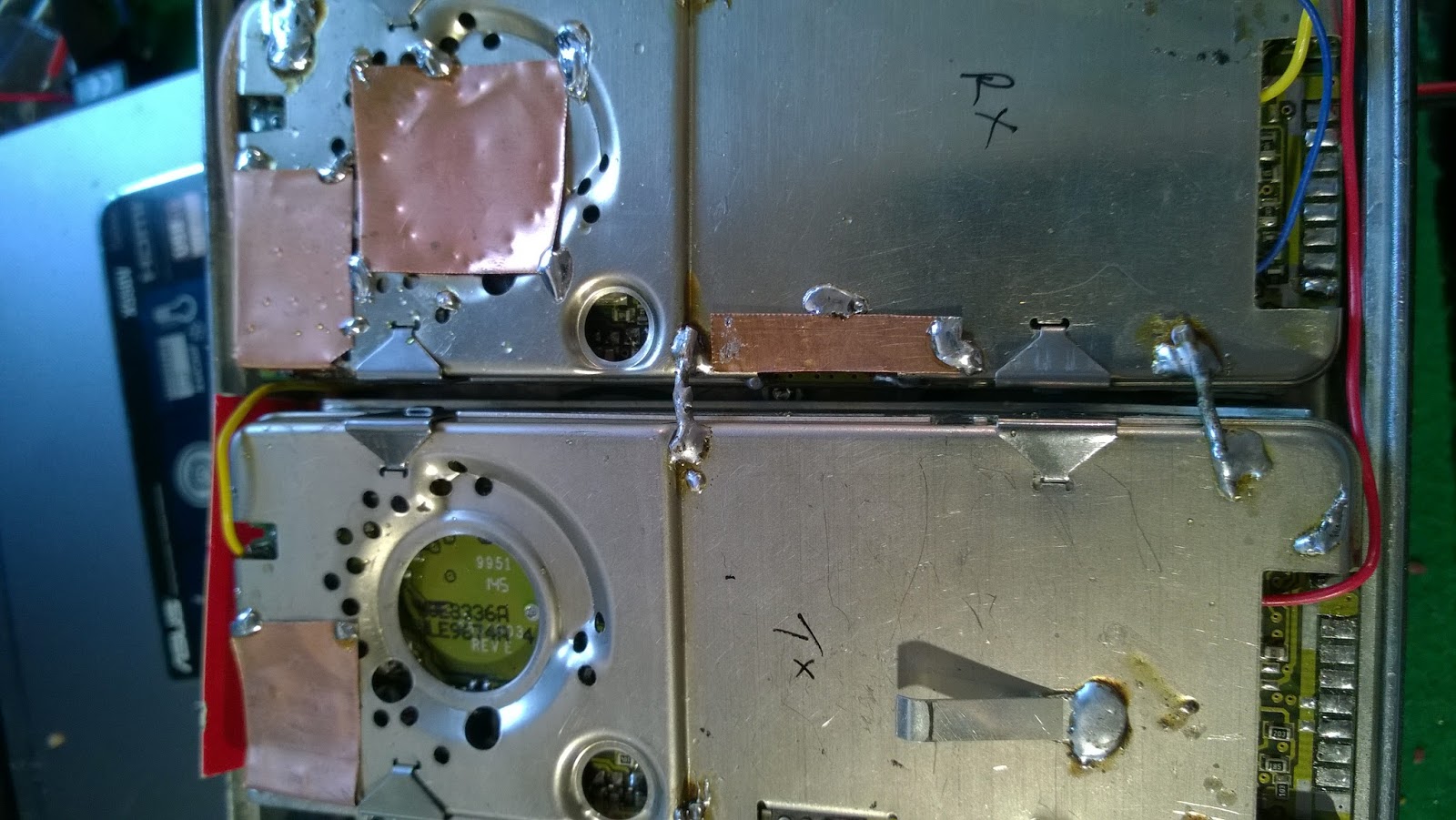
The little UHF Repeater.


Some more shielding.


The code is on Github because here will be a mess: 

https://github.com/yo3hjv/Arduino-Repeater-controller/blob/master/README.md


29 August 2014

My Dream "GO-BOX" for emergency communications. Or just for fun!

Well, I sibscribed recently to a FB group dedicated to emergency communications. Its a very nice group.
I do not believe in the FB because it's like the sand. You write something or find something but soon it's hard to find it again.
I like very much to have the possibility to go somewhere and try to make some QSO's. I am not a contester and I appreciate a nice chat with a fellow ham from here or anywhere. Therefore, I realise i really need a "GO-BOX" or a "GO-KIT" able to work all mode, all frequencies from HF to UHF.
Also the kit will be good for RVSU which is a network of hams involved in emergency communications for various NGO's here.
I will tell you my secret: My GO-BOX is on wheels!
It's a Nissan X-Trail "doped" with a lot of ham-stuff.

The main radio is a ICOM IC-7000 mounted in the trunk and the front panel remote. I finally made the permanent setup; the radio is under the trunk hood, bolted with the optional DC filter (OPC-639) and on the HF side I put a choke Balun  to reduce the common mode currents from the Codan antenna (or any  othe HF antenna) because the IC-7000 remote head is very sensitive to that issue.

The remote head is under the radio; i put it in place with the help of some industrial 3M velcro. In the left side is a small loudspeaker connected to the remote head. I use that velcro also for phones, portable radios etc...


The main attractions is the Codan 9350 auto-tuning antenna. Bulky but with outstanding performance, it's definetly a magnet for everyone's eyes, in march or in parking lot!

I wrote in other post about the custom mount for this antenna and about the connection with ICOM IC-7000 radio.

What I did lately was to put all the important wires in a protection harness.

 The main 12V DC is in harness, the RG58 and the command cable for the ATU antenna is in the harness also. Was a little tricky but the final result is amazing!


For VHF and UHF I use quarter wave antennas. I found that if I put a quarter wave on VHF, the same antenna is resonant also in UHF! A MMANA-GAL simulation showed that the UHF angles are somehow elevated but still a +2db at 0-15 deg. over the horizont so the antenna can be used well.

I preffer NMO (New Motorola Mount) for my mobile antennas. This is a special designed mount to accomodate proffessional antennas ant to whitstand to all the special conditions on a  mobile setup in full run. Do not ignore that! And also, keep in mind that a fixed mount is BETTER than any magnetic mount.

Here it is a NMO mount, VHF quarter wave antenna.


Now, for really serious things like emergency comms., I have a little toolbox with a 35 Ah SLA battery.
I was looking for a good battery eliminator but the price was too high and had to buy it from overseas! Hey, I think a little here and I know how to use a solder iron. Or solder station. Or something like that, you figure out...

So I made a very very simple "battery eliminator" or "separator", whatever, from a Schottky power diode. It was a bulky one, I don't know at what current is rated but did'nt burned at 14-16 Amps so must be better than that. In the little Hammond box I put a little 5 LED voltmeter to quick view the main battery status.
The later addition was a little digital voltmeter on a "Y" cable to view the voltage. Both of them are usefull.
The battery have two fuses, one for plus and one for minus.
Some hams think that if they put a single fuse, on the plus side, is enough!
Well, what if you make a shortcircuit between minus cable and the "plus" pole?

That toolbox cand accomodate the ICOM IC-7000 or anything else. In this setup made for Ciucas Trail Running (a 100 km mountain marathon) I have two Motorola mobile radios.

The lower is a GM360 VHF radio to talk to Salvamont (Mountain Rescue) teams and the upper is a DM3600 to use it with the Radioamateurs in the RVSU network (Radioamateurs for Emergency
Communications).
In order to be able to use a single antenna, a diplexer is used. Is a Diamond 2000 with modified RF cables. The original ones was too bulky and used PL and N connectors.
A lot of hams use amateur equipments for frequencies above the 146 or 148 MHz. They tend to ignore that out of the regular amateur bands, the radios are very ineffective!
I measured a lot of radios and they seems to loose power after 150 MHz and become very insensitive over 155 MHz. That's how they are made...  So, in a emergency network I found a little stupid to use deaf and mute radios! Therefore, I will go with proffessional radios for that particular case and the choice is Motorola!

A completion to my HF setup is a AH4 ATU with a collection of wires. I use two lenghts, 8,5 m and 4 m as they are not half-wave, as reccomended by ICOM to use them with AH-4.
The trick here is that I made two lenght of control cable and RF cable (tied together) so I can use 5m or 10m from radio to AH4.
The AH4 can be used for tuning a horizontal antenna (dipole) or a vertical one (erected on a fishpole stick) using 2 equal wires or 4 counterpoises with a vertical radiator. That's why there are 5 cables at the same lenght...


Well, this is my GO-BOX!

4 wheels and radios!


For final, here it is with a strange VHF antenna on the rooftop!


Most viewed posts in last 30 days