First is first...
21 April 2025
Project "Router" - 1
17 April 2025
ICOM IC-703+ de vanzare / For Sale
SOLD!
Primul meu ICOM IC-703+ este de vanzare!
Dupa un eveniment distructiv accidental (o supravoltare datorita functionarii defectuoase a unei surse de laborator), m-am incumetat inainte de Craciunul lui 2024 sa il repar.
Reparatia a durat cam o luna, primul pas fiind identificarea componentelor defecte si plasarea de componente echivalente pentru a testa functionarea.
Apoi, dupa identificarea acestora, au fost comandate piesele originale, unele dintre ele avandu-le deja "pe stoc", achizitionate preventiv in urma cu multi ani (celebrul uPC2709).
Dupa aducerea in stare de functionare, am instalat si un filtru Collins CW de 500 Hz, YCF-115C.
Pentru ca am doua, acesta este de vanzare.
Se da impreuna cu microfon HM-173.
Cablu de separatie, bonus!
Pret: (400 Eur) - 2000 Lei + transport prin curier.
Disponibila fisa de service in care sunt evidentiate toate reparatiile. Contact prin email, indicativul @ gmail
Da, sunt doua! Al doilea a ajuns la mine prin bunavointa lui YO3FX (SK) care stia ca sunt in grea suferinta dupa primul...Capacele au fost reconditionate.
Suruburile din pozele de mai jos au fost inlocuite cu unele compatibile, cu cap inecat, intocmai ca cele originale.
13 December 2022
ICOM AH-4 tuning aid with any radio
Somehow, you end up into an ICOM HF eco-system.
You have an IC-7300 or 7100 or 7000 or anything else; a radio that can do HF and you also have an IC-AH-4 the "wonder ATU" from ICOM.
You mod it to be more modular and portable as I did, ready for field use.
Maybe you want to use some other radios on the same antenna system or you want to go portable with a Xiegu G90 and you said to yourself: "I could put that AH-4 to good work but the ATU will not work with anything but ICOM radios".
Well, you may be wrong!
The AH-4 can and should be used with other radios because it is a small gem! But how?
A small independent control box can be used with other radios to tune various antennas, from wires to loop antennas and this is what I done recently.
It is in a crude form, maybe I will make it with the help of a microcontroller or maybe I will leave like it is now because, it is working well!
What do you need?
-ICOM AT connector;
-One Red and one Green LEDs
-Two PCF817 or similar optocouplers;
-Two 1N4148 or 1N4001 diodes (not mandatory);
-Three resistors between 1.2 KOhm and 2.2 KOhm (these values where tested);
-a temporary SPST push button;
-a small test PCB or any other solution to mechanically fix all together.
The schematic:
How this is working?Power up the box. The Green LED will lit.
START and KEY have 5V (UP).
Set the radio to 5W in carrier mode (AM, FM, CW) and press PTT or CW Key.
Momentary press the button TUNE. The RED LED will lit.
The START line (from radio to ATU) will go down; the ATU will respond with KEY going down for the tuning cycle (request for carrier). Side note: if you didn't press the PTT or the CW Key before pressing TUNE, now it's the moment to do that!
During the tuning cycle, the AH-4 will request from the radio (which is not connected to the control lines) to transmitt a 5 W carrier.
Thus the IC-1 LED will lit and the corresponding transistor will keep START line down as long as the tuner need for the tuning cycle. Keep PTT or CW Key pressed on the transmitter.
When the RED LED is going off, the tuning solution is achieved.
Note: there are situations when the tuner will not find a solution for the antenna; the RED LED will go off and will lit again, the tuner will start a second sequence then will go in bypass mode.
I suggest using a small SWR meter between the radio and the ATU or watching the built in SWR meter to be sure a tuning solution was aquired.
This is my version:
25 May 2022
ICOM IC-7100 E Extended frequency Mod
Our EmComm group ( RVSU ) is using the IC-7100 from ICOM as primary HF Radio.
We therefore must be able to use it on the full range of frequency so we "mod" it.
Actually, we modified the configuration diode matrix so the radio will TX from
0.1 MHz - 199.999 MHz and
400 - 470 MHz.
It will still not transmitt AM on the VHF and UHF.
ATTENTION!
-The modification cand damage your radio!
-Do not transmitt out of the authorisation privileges!
-I have no responsibility for what are YOU doing with YOUR radio.
Pictures are said to worth thousand words, so I give you two thousand:
Before
After
The removed diodes are soldered on one side of the pads just to have them handy when the mod will be reversed (if needed).
19 May 2022
ICOM AH-4 Automatic Antenna Tuner modification for RVSU
The Spring is here full power so is the war just North of Romania so our Emergency Communication Team (RVSU) is preparing for... field day!
Our standard in HF EmComms are ICOM radios and ATU's; we are using IC-7100 as our main HF radio paired with T2FD antennas for NVIS and AH-4 with verticals and wires for various Long Range HF.
In this post I will briefly show one modification for the AH-4 Automatic Antenna Tuner (one of the best in my opinion, for 100W output power).
It consist in changing the way the Coaxial RF cable and the Control cable are connected.
Because our concept is based on modular kits, the AH-4 must be able to be installed quick, reliable and we must have provisions to modify the setup if the field conditions required so and this must be done by operators with minimal training.
The standard ICOM AH-4 box include, among other things, a 10m LMR coaxial cable and 10m of 4 wire control cable terminated with the infamous MOLEX connector present in ICOM HF radios.The way those cable connect to the Tuner box is pretty against "field use" principles therefore, a solution must be found.
After a few years of playing with my own AH-4, I concluded that it is not acceptable to open the case of the tuner anytime the cable must be connected or disconnected.Another problem is the fixed lenght of the cables. Just 10m might not be enough in certain scenarios and while another coaxial can be added with the help of a female-female adapter, require intimate knowledge from the field operator and present some fatal risks for the integrity of the radio or the ATU if the wires are connected in the wrong way.
So, another solution must be found!
We are not using the ATU in permanent setup so, some measure originally designed to prevent the water or moisture ingress can be reduced in order to accomodate some that can give more simplicity in installation and use.First, the RF connector must be moved from inside the ATU to the outer case.
The SO-239 (UHF-female connector) will be seated just where the cable clamp was.
The connector is a good quality one, from Amphenol.
Unfortunately, the plastic will not support the mechanichal stress of the connector so a small plate was cut from a piece of Aluminium.
Then, the ATU's case was prepared to accomodate the SO-239; the backplate was threaded for 3mm screws for better electrical contact.
Everything fits.
The lower left screw is longer. This is because there will be the Ground connection for the small piece of coaxial cable from SO-239 to the ATU's PCB.
This coaxial patch was made from some cable left from GSM sites and I know it can handle easy 100 W up to 100 MHz. So, I prepared it to be used here.
I removed the original piece of metal with the old SO239 and make some scratches on the Ground pad to install the coaxial patch.
I found a little piece of metal, soldered it onto a metal shield and put some heat shrink tube on it to fix the coaxial patch firmly in place:
Looks good and it is the time to take it to the next level: the control cable.
A few words about choosing the right cable:
In the field you need various lenghts of cables. Often those cables are cut, lost, or even forgotten at the base.
The ATU is drawing less than 1 Amp, typical around 200 mA. The control signals are at TTL logical level (5V) and the "protocol" is nothing more than pulling to ground or to +5V so nothing special with this cable must be observed.
Can be a cheap cable and it is desirable to be found easy. Long story short: what if I could use a FTP cable? Well, on my balcony I have an AH-4 which is connected to the radio with this kind of cable and for 2 years performed extremely well.
The problem with my AH-4 is that i modified it very ugly; the female RJ-45 connector is placed on a cut into the case and, believe me, it looks bad!
In this case, I decided to use something that I already have in my junk box from a never-finished project. A RJ-45 female-male patch cable designed for panel mounting.
I was a little bit nervous because I thought the lenght of the patch cable was not enough to go from the upper case of the ATU to the PCB...
Checked and it was just the right lenght! So, I could start making the square hole from the round one!
... it fits now:
And this how it is. I put some hot glue to seal the holes but I forgot to take pictures...
At the other end of the control cable, a wall RJ-45 connector was tied to a MOLEX ATU connector. Fortunately, I bought some kits a long time ago so I could make it fast.
This is the electrical diagram for the RJ-45-MOLEX adapter:
... and this is how it looks:
Yes, I know, it's horrible but this is what I found at nearest store to me. I promise I will search for other solution but this is it, for now.
Now we can use (almost) any lenght of network UTP cable and (almost) any lenght of coaxial changing them in the field. And, if there is need for the network cable to our applications and no need for HF, we can use the cable for that purpose.
I hope this is an usefull ideea and will inspire other "brave hams"...
Some notes:
73 de YO3HJV, Adrian.
18 October 2021
ICOM FL-53A CW Filter
I was reading a post in a FB group. Someone was asking for a CW IF filter for his ICOM IC-703 radio. Specifically for a F-52A, CW 500 Hz 455kHz filter.
Well, I remembered I had some filters and I searched for them. Surely was there, a FL52 and a FL53A (250 Hz).As I already have a FL-52A into my IC703, this one stood a looooong time in the shelf.
While I took a picture of the FL53, I noticed there is a serial number on the filter. The serial number was 501 and i thought, "Damn, just five hundred of these untill i got mine"?
Then, I was courious and opened the other filter, the FL-52A. And, surprise, this one was "001"!
So, I got the first FL53A filter from ICOM!!! Dude, brand new, in the original box, mint condition!
Should I start a collection?
I wrote a request for informations to ICOM, I hope they will answer!
19 April 2021
ICOM External Antenna Tuner Connector & Stuff
I had some projects to made and those involve external ATU connectors for ICOM radios; I think it's better to have some informations here for anyone looking for them.
Electrical connection for ICOM External ATU 4 pin MOLEX connector:
Thus I searched on various retailers for those connectors and I found them made by Molex.
The connector case manufacturer's code is 03-09-2041.
The crimp pins manufacturer's code is: 02-09-2103
You can buy them from MOUSER:
Connector-Mouser part: 538-03-09-2041 TARIC:8547200090 ECCN:EAR99 COO:US
Pins-Mouser part: 538-02-09-2103 TARIC:8536699099 ECCN:EAR99 COO:US
Icom to LDG antenna tuners electrical connection:
Simple Push To Tune interface schematic:
ICOM IC-706 ATU
ICOM IC-703 ATU
ICOM IC-7100 ATU
ICOM IC-7000 ATU
ICOM IC-7300 ATU
ICOM IC-7600 ATU
ICOM IC-746 ATU
ICOM IC-718 ATU
07 June 2020
ICOM IC-7100 Headless test
Here is a small video.
I am not particular happy with my voice so the video is self explanatory.
I don't have my laboratory tools here on my second QTH but I thing I can investigate a little the serial comm with the Controller to see if it is possible to send it through the Ethernet
73 de YO3HJV
PS
For my reference:
10 May 2020
HF Arduino Beacon project
This are the features I was thinking of:
-Connected to ICOM IC-7100 via CI-V serial interface;
-Can send Baro, temperature and humidity;
-Send at regular time intervals;
-Send in several frequencies;
-Send at various power levels.
Will be based on a Atmega 328 uC and will have a DS3231 RTC and BME-280 sensor for meteo info.
DS3231 was chosen for RTC because it have a very precise, thermo-compensated oscillator and keeps time very accurate. Also the local temperature is available for processing it.
BME-280 is a high precision array of sensor measuring relative humidity, temperature and barometric pressure.
It will operate from my second location in KN25UC, abt. 6 km West form Campina and 90 km N from Bucharest.
I am using a Hustler 4 BTV vertical multiband placed directly on the ground and one of my ICOM radios.
If you have suggestions, please leave a comment below.
08 April 2020
Triggering preset Voice memories and CW Memories on IC-7300
The PC send to the radio the following:
$FE $FE $to $from $28 $00 $## $FD
## - Memory Location
2. CW Memory M1 - M8
It cannot be sent directly by a dedicated command via CI-V. (found it hard way, confirmed HERE)
Therefore, a workaround can be done like this:
1. Read the memory by sending
$FE $FE $DEV $RADIO $1A $02 $## $FD (## 1 to 8)
the radio will respond with byte string
$FE $FE $DEV $RADIO $1A $02 ____ 70 bytes $FD
2. Load the bytes into an Array
Mem1[77] ; The Array will have 6 bytes preamble, 70 bytes message, 1 byte STOP BYTE (EOM)
3. For (int i = 6, i<=76, i++)
{ byte CW = Mem1[i];
sendPreable();
sendCW();
mySerial.write(CW);
sendSTOP();
}
This will send the stored message.
06 April 2020
ICOM CI-V IC 7300 commands
-All end on $FD
Send CW characters
| $FE | $FE | ra | $E0 | $17 | $xx | $FD |
Tuner On/Off
$FE | $FE | ra | $E0 | $1C | $01 | $01 | $FD |
Delta TX On/Off
| $FE | $FE | to | fm | $05 | $21 | $00 | $08 | $13 | $01 |
20 March 2017
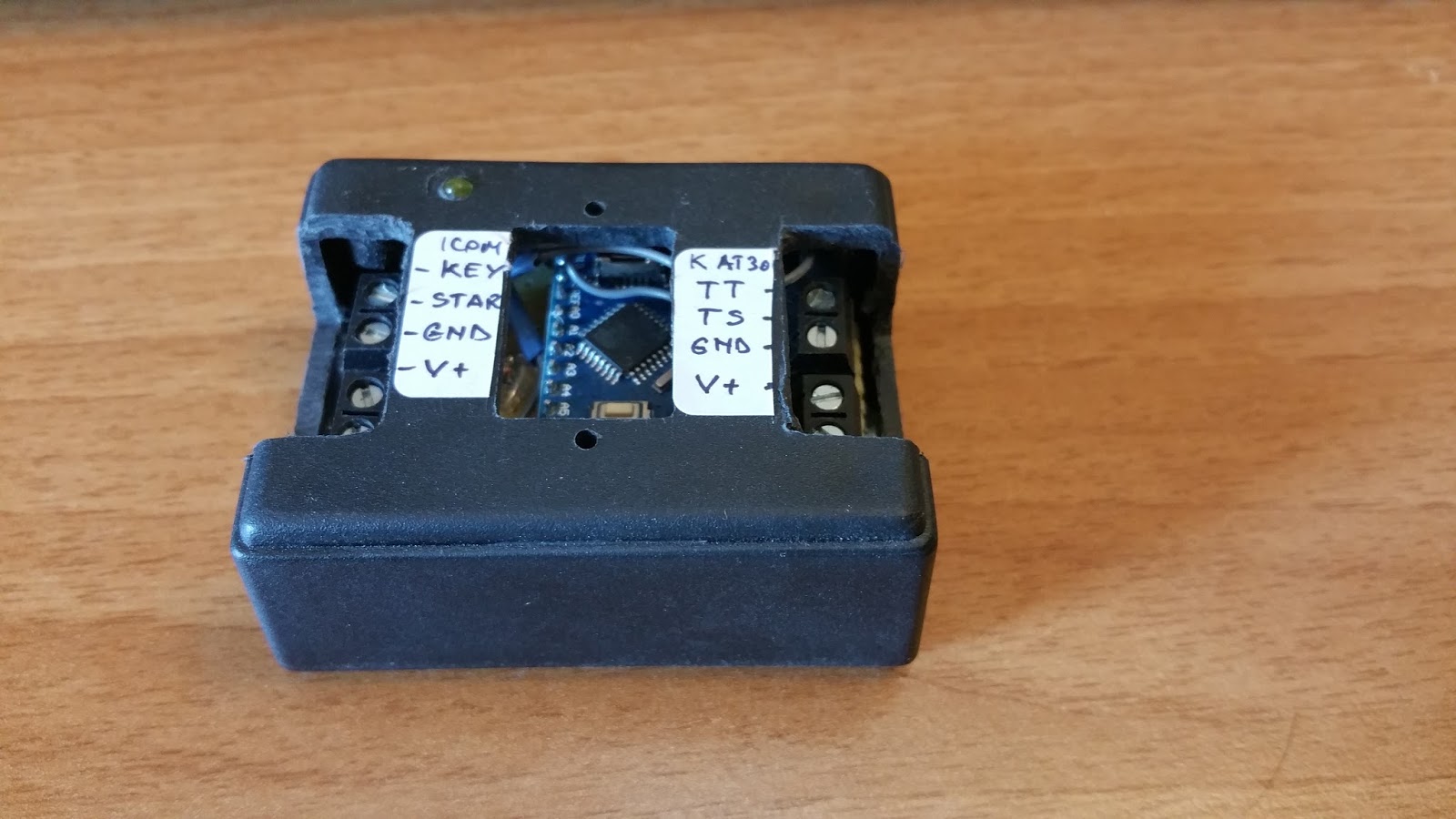
Kenwood AT-300 ATU to ICOM Radio - II
Here is the connection diagram (again, by hand) and the final iteration of the code.
Later edit:
This is the final look after some work on a test PCB. I let the USB port accesible for future development:
09 March 2017
Kenwood AT-300 ATU to ICOM Radio - I
I tried to find on internet something already made but no chance. Looks like the Kenwood AT-300 is very rare or the fellow hams are using it as is intended, with a Kenwood radio.
It's not my case so, after a couple of years of thinking, I put myself together and I start to explore the possible solutions to connect the ATU to my IC-7300 radio.
First, the radio has a START and a KEY line and the "0" logic is +5V and the '1" logic is 0V. Same as the AT-300 which is good. The Kenwood AT-300 has the same voltage logic but the signals are TS and TT.
Basically, the Kenwood tuning procedure is:
-The TUNE on the radio is pressed
-The radio pulls down the TS line AND start transmitting around 10W CW.
-The AT-300 respond by pulling the TT down after about 100 msec. ONLY IF RF IS PRESENT.
-If a tuning solution is found, the tuning stops and the TS line is pulled up to 5V.
-After 15 seconds, the radio stops the RF and pulls up the TS.
-If the TT is still up, the radio return TUNING ERROR. If the TT pulls up BEFORE the TS, the radio show TUNED.
For bypass, the TS is pulled down for 500 msec. WITHOUT RF. To put the tuner in circuit, repeat this sequence.
The ICOM radios, have a slighty different "tuning protocol":
-The radio pulls down the START line.
-The tuner pulls down the KEY, causing the radio to transmit 10 W CW
-If the tuner found a tuning solution, the KEY is pulled up. From what I found using the Codan 9350 antenna, there is no time limit for keying the radio!
-If there is no tuning solution, the KEY is pulled up, then down for 70 msec. and then up again (and rest up).
The solution seems that is to "alter" the KEY and TS sequence with a microcontroller (Arduino).
Something like this:
-Press TUNE on the radio
-The radio pull down START
-The uC detect the START and pull down TS
-uC pull down KEY to transmit 10W CW
-uC monitors TT and pull up the KEY if the TT goes UP.
-If TT is still down after 15 seconds, the uC execute "TUNE FAIL" sequence as expected by ICOM radios.
Already made the test board. initially i thought to put some optocouplers for TS/TT and START KEY but after monitoring the voltages I saw no problem to connect them directly to the Arduino digital ports (max 5V). Of course, the signal lines are connected through some 470 nH inductors and the uC pins have 10 nF capacitors to the ground.I believe this interface will be good to use it also on IC-7000 (have one and i will test it) and IC-7100.
Stay "tuned" for the next step!
73 de Adrian YO3HJV
LATER EDIT
Here is the first version of the code. Simple tuning, start and stops at the TUNE command from the Radio front panel command.
About the hardware:
The lines are directly connected to the Arduino board and the lines from the ICOM radios are tied up to +5V with 4k7 resistors in order for the radio to "see" the external ATU!
Be aware that, if the output power is not set to be between 5-15W, the radio will turne to the INTERNAL ATU instead of the external, even with the lines pulled UP!
Most viewed posts in last 30 days
-
Kenwood Programing Software FIRMWARE: KDS-100 504XXXXX 4A46 PTT ID Display feature 176.86 KB CURRENT 401XXXXX F7FC Corrects lock up whe...
-
Icom IC-7300 wide band modification by PA2DB: Remove bottom and find the diode matrix (near big chip) Open RX 0.030-74.8Mhz (REMOVE D...
-
Icom programming Software GM-110SC rev.1.2. ex1725. IC-3FX 245MHZ THAILAND CB HANDY RADIO, EX2020 REV 1.0. IC-3FGX 80 CHANNELS 245MHZ THAILA...