21 January 2012

Lustraphone mike, another piece of junk restored...

A few months ago I visit a friend of mine.
In his backyard I found a big stock of junk.
Searhing for some interesting, I found a nice desktop microphone who look a little odd!
I took it for nothing.
Unfortunately, I didn't took any picture before I start to open it. The images here are after some cleaning...
At home, after a little thinking, I opened it and found that the microphone is made by LUSTRAPHONE in England.
A nice transformer was fitted under the transducer. The output is balanced at around 600 Ohm.


I search on the Internet but I found almost nothing about this type. Only this site is exhibit a identical one, only for hire!
I removed the old paint which was horrible and sprayed with a matt-black one.
On the chromed pieces I work witha Dremel brush and restored the shining for a nice contrast.
The front of the transducer was covered with a dense copper mesh which was unrecoverable so I removed it.
The switch is the original one (Labeled also with LUSTRAPHONE). It is a double-section two position but one section was unusable (in shortcircuit) so I had to use only one...

The final result is this (click on photo for larger view):


I used it on a FT-2000 and the audio reports were great!
Nice piece...

Why Lustraphone Ribbon Mike was never at BBC.


Some info about LUSTRAPHONE:

Lustraphone was a contemporary of Grampian and Reslo from the 1950s -- all British microphone manufacturers building ribbon and moving-coil mics mainly for the amateur, semi-pro and PA industries. (http://www.soundonsound.com/sos/mar02/articles/qa0302.asp).

It seems that hey invented the noise cancelling microphone!

19 January 2012

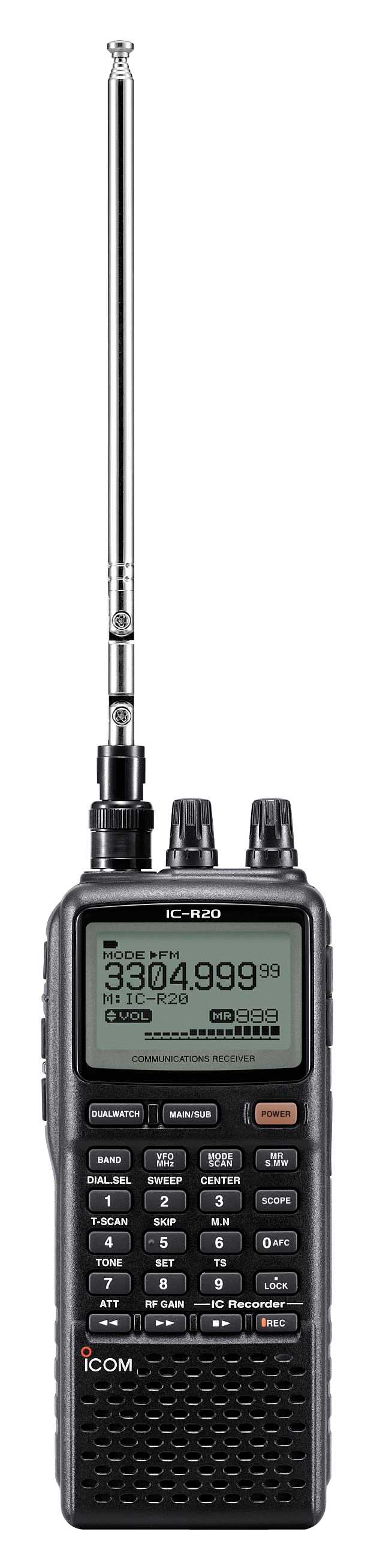
Ten things about ICOM IC-R20 (and more)

ICOM just announced that IC-R20 is not longer in production. 
I still have mine.

I have this pretty communication reveiver for more than 2 yrs. I had a lot of fun with and found a lot of use especially on my experiment bench but also to listen to various stations while travelling.
One of the main benefits is the enourmous autonomy from the LiIon battery which keep the receiver "alive" for more than one week. Of course, with some moderation to the loudspeaker volume and around 2 hrs/day listening.
The full characteristics of the ICOM IC R-20 "A.K.A. "features"are to be found on various places on internet so I do not want to trick you to land on my page for this, HI.
Instead, I will emphasize some of the features and some of the missings of this radio.

1. The SSB is missing above 470 MHz. This lead to impossibility to trace faint signals with a waterfall software (like Spectran or SpectraVue);
2. The excessive sensitivity of the front end sometime make impossible to listen to some signals in a strong RF environment; fortunately, the RF level CAN be applied simultaneous with the RF ATTenuator.
3. The memory and scanning is a little weird for someone used with transceivers. Banks and lists are too complicated but I believe it is hard to organise more than 1k slots.
4. A big plus is the "onboard" recorder though the audio format ( .icw) used is obscure and not supported by the programming software. One have to upload the recordings into the scanner and listen with the IC R20 which is stupid! really stupid. But there is solutions! The squelch-activated recording is a nice feature! The audio file format is weird but I have a conversion software (see links below)
5. The original antenna seems to be fragile but I didn't manage to broke. Yet! (still OK in May 2022)
6. The LCD screen is "the best". Simple and effective, visible in the full sun and also at night. The backlight is also, one of  the best I ever seen.
7. A high level of IMD above 1.5 GHz made this radio tricky to use on some SatCom. I didn't tried in remote places and Bucharest is not the best place for that kind of weak signal receiving.
8. The audio jack is shared with the CAT (CI-V) port. It is mandatory to have some kind of separation between when using headphones. Or to hack a headphone to use it. The built in speaker is not so loud so one will take benefit from a headset in noisy environments.
9. Excellent below 30 MHz and exceptional above 100 MHz; The BC receiving is very nice and the autotune is working well. The SSB is pretty like on a big transceiver.
10. Very quick on scanning memories. Also, the CTCSS/DCS scanning is working very nice.

OK for now...
What about the software? one will ask...

So, there is a programming softare. CS-20 is the "name". With this you will be able to programm the memories and banks. You will be able also to download the recorded communications.
To listen to that recordings is a different story but it is a solution.
You have to use a ICW2WAV utility (audio conversion software)
Also, a steady hand will be able to take the last IF (450 kHz) and send it to a SDR receiver to decode unusual modes while tuning above 1 GHz!
You can use Ham Radio Deluxe to controll the Icom IC R20. With DRM you will be able to decode most of the digital modes below 470 MHz and if you made the IF mod, you will be able to "unleash the beast"!

This are hard to find so, let's organise the files (links updated at 18 May 2022:

-Programming software CS-R20
-Service manual;
-If needed, here are OKI DLLs (OkiAudio.dll, OkiAdpcmEnc.dll, OkiAdpcmDec.dll). Unzip them and copy into the ICW2WAV folder. 

Please, be aware that the software is hosted on external server. 
Use a antivirus software to scan for problems before installing and make a  backup copy because I do not how much that will be there!

73 de yo3hjv

Later Edit

So, just happened! Told you to make backup copies!
Fortunately, I was able to find them again so, the links are updated (18 May 2022).

LLE (August 28, 2015)
After more than 3 years after the first impressions and tests with other scanners, I strongly believe that ICOM IC-R20 is the best comm. receiver.scanner at his category (portable/handheld). It's not cheap but the quality has a price!
The LiIon battery is doing fine, after this years keeping the radio running for a week or more on moderate use.
There are hardware mods to use a RTL SDR on first IF; one can have all modes on the entire receiving range but a very steady hand and good eyes to do it.
The original antenna is doing fine, beating the record on this kind of antennas!
I was sorry to heard that the rado is no more on production so, if you find one on stock somwhere, grab it before anyone else will do it.

Definetly, a keeper!

LLLE (May 2022)
I still have it. I can't find the battery holder skeleton but the original LiIon battery still hold the charge like a new one. 
The receiver is still in good shape altough the rubber caps are starting to worn and to show the age.
At some point I considered sell it and buy the new Icom IC R-30 but I am very pleased about this one.

18 January 2012

Save WIKIPEDIA!


Knowledge is power! When someone try to conquer this kind of power in the present, the history and the future are in danger! Please, read Orwell, save and preserve The Free Knowledge of Wikipedia! Let us have past, present and future! Without this, all we'll be soon nothing but slaves!
Say no to Internet Censorship!
www.wikipedia.org

15 January 2012

International HF "Bucuresti" Contest 2012

We are almost ready to propose you a new format for the traditional BUCURESTI Contest!

Here is a teaser. More information will be soon available on the official page at YO3KSR.


GL & GDX & Happy contesting!
73 de YO3HJV


Organizer:

Romanian Society of Radioamateurs–YO3KSR Club

Date:

March 19, 2012, 16.00-18.59 UTC

Bands/Mods:

80 m

CW – from 3510 to 3560 kHz;

SSB – from 3675 to 3775 kHz;

PSK31 – from 3580 to 3590 kHz

40 m

CW – from 7010 to 7035 kHz;

SSB –from 7090 to 7100 kHz, and from 7130 to7200 kHz;

PSK31 – from 7040 to 7045 kHz

Categories

Can be chosen one of these categories:

- A - QRP - (max.5 W PEP) single operator

- B - LPI - Low power - single operator (max.100 W PEP)

Note: equipment used at this category must be limited to maximum 100W PEP. If transmitter is capable of more than 100W PEP operator must reduce the power at maximum100WPEP

- C - LPG - Low power group – two or more operator (maximum 100 W PEP)

Note: equipment used at this category must be limited to maximum 100W PEP. If transmitter is capable of more than 100W PEP operator must reduce the power to maximum 100WPEP

- D - SWL - receiver (only category « MIXT »)

And one of these working modes:

-E – Mixt – any of two or more transmission modes

-F – Phone – SSB

-G – CW – Morse code

-H – Digi – PSK31

Reports:

- YO stations: RS(T) + serial number starting with 001 + 2 letters code (Bucharest district (a.k.a “sector”) code XA-XF for YO3 stations, or county code for YO counties).

Operators with YO3 prefix will give the report as follow XA-XF only if the transmitter is located in Bucharest XA-XF districts (a.k.a “sector”), if not will give the report accordingly with the county/country where is located the transmitter.

- Foreign stations (other than YO’s): RS(T) + serial number starting with 001 + 2 letters code (code= internet domain. E.g.: Russia=RU, Hungary=HU, Bulgaria=BG, Moldova=MD etc.).


Score

A. YO stations:

- 1 QSO YO3 - YO3, YO – YO, YO – Foreign= 2 pct.

- 1 QSO YO3 - YO, YO - YO3, YO3 – Foreign = 4 pct.

B. Foreign stations:

- 1 QSO with a YO operator or Foreign = 2 pct.

- 1 QSO with a YO3 = 4 pct. (only for transmitters that are located in Bucharest’s districts)

SWL: must log both call signs and both controls transmitted, maxim 5 consecutive QSO’s with the same call sing.

Multipliers: number of counties (AB, AG,... etc.) + number of country codes. (see Appendix) + number of different Bucharest districts YO3 (XA, XB, XC, XD, XE, XF)

Note:

Operators are entitle to work with any station once in CW, once is SSB and once in PSK31 according to band plan described above and multiplier will count only once in such cases. Also QSO’s logged in different bands with same station are scored with the same number of points

Final Score

Final Score = (summ of points of the two bands 80m and 40m) * (summ of multipliers of the two bands 80m and 40m).

05 January 2012

Vasile Ciobanita, YO3APG - SK

Postez aici, cu intarziere, stirea care deja se cunoaste. Vasile Ciobanita, YO3APG nu mai este intre noi.
Astazi s-a dus sa se odihneasca.
Inainte insa de a se retrage definitiv, a facut ceea ce ii reusea de fiecare data: Ne-a strans din nou laolalta.
Am senzatia insa, ca azi a fost pentru ultima data!
In pofida celor care vedeau in el sursa tuturor relelor din radioamatorismul romanesc, m-am incapatanat sa vad un om care si-a pus o mare parte din energia sa (daca nu intreaga) in slujba radioamatorismului.
Am facut abstractie de sistemul in care evolua si am preferat sa il cunosc si sa il stimez ca om si mi-am permis sa il banuiesc de cele mai bune intentii.
Era peste tot, raspundea tuturor, stia o multime despre multe. Si nu numai despre radioamatori si radioamatorism.
Chiar si atunci cand avea o opinie diferita, discutia in contradictoriu era placuta si aveai la ce sa te gandesti.
Am fost criticat si eu si el pentru calitatea de "Membru de Onoare" al Societatii Romane a Radioamatorilor dar niciodata nu a vrut sa spuna cine anume il critica. Era discret si chiar si aceasta discretie i-a fost reprosata de multe ori.
Sunt multe de spus despre cum a influentat subtil drumul prin radioamatorism al multora si sunt destui care isi datoreaza o cariera lui Vasile. O vor face altii, sunt covins.
Viata e uneori aiurea si te lasa descoperit atunci cand te astepti mai putin.
Acum, Vasile ramane intre noi prin prin carti, inregistrari de QTC, cateva inregistrari video si multe, multe, tare multe amintiri raspandite in toate indicativele cu care s-a intersectat.

Cea mai puternica amintire a mea este cand, intr-unul din putinele momente de liniste, m-a tras deoparte si mi-a marturisit ca de abia asteapta sa se retraga pentru a mai face cateva legaturi caci ii lipsea tare mult asta!

73 de YO3HJV

PS.
Stiam de dragostea sa pentru munte si am descoperit ca nu numai radioamatorii l-au "avut" pe Vasile ci si montaniarzii! Clubul "Floarea de Colt"
este marcat de aceasta disparitie.

27 December 2011

CODAN 9360

Today I get my Codan 9360...
I dreamed a lot at this radio, for the last 3 years, seems to be impossible to get one!
So, this is my X-Mas gift from my wife :-) Nice!

This unit is full 2-30 MHz TX capable, with front keypad programming mode.
This is somehow complicated because there are only 12 controls (10 keys and two opto) and the menu is very, very complicated!
Not only this, but the engineering is weird for a ham!
I think I will need the programming software to put the frequencies into the Eprom and also make ALE to work with HF-ALE ham radio network.

This is a small video I made when I was in QSO with YO2LGX and YO2LEO.
73 d YO3HJV

18 December 2011

My "HELLO WORLD"

In these days seems that you cannot light a simple LED without a very complicated electronic hardware (microcontroller with some Quartz Crystal around it etc).
So, I started to become interested in these "chips" becuse I do not want to be so "obsolete"...
First, I started by searching a development board...
I soon received from a fellow ham a EasyPIC 2 Development Board fitted with everything you want.
After that, I stated to search for a suitable PIC to start with. A 16F877A seems to be the best for a beginner because has A/D converters and a lot of I/O ports.
The interest in PIC was determined by the need for some repeater automation, including battery management.
After a lot of struggling, I manage to read and write the PIC using the onboard USB programmer. This was by far the most time consuming phase (a few weekes of study). Don't laugh! I have no one to help me but some internet related posts!
To make the long short, after a successfull R/W operation, I manage to blink a LED but this don't count as a "Hellor World" project because was made with a downloaded .hex file!
I read (and trying to understand) various things about uC.
I soon found that I need a Programming tool and a compiler.
Everyone pointed me to MikroE solutions: MikroBasic and MikroC. Also I read Mr's Surducan book about microcontrollers and JAL (Just Another Language) as reccomended by some uC specialist.
After a lot of reading (and sometime "lot-of-no-understandings") I stayed on BASIC.
This is my first, true, "Hello World" project:

;Chip Settings
#chip 16F877A,10
#config OSC=HS

;Defines (Constants)
#define DISP_COUNT 4
#define DISP_SEG_A PORTB.0
#define DISP_SEG_B PORTB.1
#define DISP_SEG_C PORTB.2
#define DISP_SEG_D PORTB.3
#define DISP_SEG_E PORTB.4
#define DISP_SEG_F PORTB.5
#define DISP_SEG_G PORTB.6
#define DISP_SEG_DOT PORTB.7
#define DISP_SEL_1 PORTA.0
#define DISP_SEL_2 PORTA.1
#define DISP_SEL_3 PORTA.2
#define DISP_SEL_4 PORTA.3

afis:
DisplayValue 1, 0
Wait 1 s
DisplayValue 2, 1
Wait 1 s
DisplayValue 3, 2
Wait 1 s
DisplayValue 4, 3
Wait 1 s
DisplayValue 1, 4
Wait 1 s
DisplayValue 2, 5
Wait 1 s
DisplayValue 3, 6
Wait 1 s
DisplayValue 4, 7
Wait 1 s
DisplayValue 1, 8
Wait 1 s
DisplayValue 2, 9
Wait 1 s
Goto afis


This program is intended to be used with a 16F877A Microchip PIC,
a 10 MHz crystal and a 4 digit, 7 segment LED display.
It count from 0 to 9 but the number is displayd alternatively from left to right.
As I cannot attach the .hex file, use Copy/Paste and a txt editor to make your own hex file
to upload into the uC:

:020000040000FA
:020000000528D1
:100008000900B0209F200130A100A0015920013033
:10001800F40097200230A1000130A00059200130DF
:10002800F40097200330A1000230A00059200130CD
:10003800F40097200430A1000330A00059200130BB
:10004800F40097200130A1000430A00059200130AD
:10005800F40097200230A1000530A000592001309B
:10006800F40097200330A1000630A0005920013089
:10007800F40097200430A1000730A0005920013077
:10008800F40097200130A1000830A0005920013069
:10009800F40097200230A1000930A0005920013057
:1000A800F4009720072863005828200AA300C220DC
:1000B800A200061086100611861106128612061373
:1000C80086130510851005118511210303190514E0
:1000D8000230210203198514033021020319051582
:1000E800043021020319851522180614A218861453
:1000F80022190615A2198615221A0616A21A86169C
:10010800221B0617A21B86170800F30AC030F1004D
:100118000330F000F00B8E28F10B8C28F20B8A28A4
:10012800F30B8A280800E830F2000330F300892036
:10013800F40B97280800831603130610861006117F
:1001480086110612861206138613051085100511EE
:1001580085118312031308001F10831603139F13BE
:100168009F111F159F141F1007309C008312031343
:100178008501860187018801890108000B30230267
:10018800031800342308013E0310D03EA3000030BA
:100198000318013E8A00230882000A343F340634DB
:1001A8005B344F3466346D347D3407347F346F34B8
:02400E007A3FF7
:00000001FF

14 November 2011

11 November 2011

October news


RadioMagazinYO, the monthly YO hams magazine is available for download HERE. It's necessary to register as user in order to dl the magazine but you can wait to the end of the month do have it without registration!
The cover story, about the YR1X ARHAB will be available as article next month.
Meantime, you can watch YR1X-11 pictures HERE.

08 October 2011

23 September 2011

2E0BLF and South Yorkshire Repeater Group steal money just like a thief!

Yes! Is a thief! He and South Yorkshire Repeater Group.
How can you name one who takes your money for a radio gear and sends nothing?
"Thief", "cheater", "con".
Well, this is Andrew "Andy" Spaxman, 2E0BLF, ex: M2UXC, who lives in 12 Stanhope Gardens, Barnsley S752QB, England (or UK ).
Shame on you Mr. Andy "Thief" Spaxman!

How it's "operates"?
Simple!
He is web-admin at this site: http://www.southyorkshirerepeatergroup.co.uk/shop/
He had a TH-79 for spares to sell. The price was nice, around 50 UK Pound. I wrote a e-mail asking him if he can send the radio to Romania. His answer was "OK" and he said that the shipping will be 25 UKP, so I sent the money via PayPal!
A long time I get no answer from him to my regards about the expedition of the radio...
When I threat him with a complain to local police, he reacted and told me that he will send the money back.
After that, a looong silence but no radio nor money, of course!
So, instead of making that complain, I decided to publish everywhere I can this story! It is now more than a year...

Mr. Andy "Thief" Spaxman has a gang! Yeah, he need a team to steal!
What team? This one:

South Yorkshire Repeater Group

Why I said that? Because the money was sent to that gang and nobody seems to care about! I was trying to contact someone from that "gang" to complain but all the email was censored, I believe!
Also, beware of the other side of Mr. "Thief" Spaxman!
He is the registrant and, of course, web-admin of the www.hostyorkshire.com:

Domain Name: HOSTYORKSHIRE.COM
Created Date: 06-Jun-2003
Expiry Date: 06-Jun-2012
Nameserver: ns2.speedydns.net
Nameserver: ns1.speedydns.net
Registrant Name: Andrew Spaxman
Registrant Company: Host Yorkshire
Registrant Address: 12 Stanhope Gardens
Registrant Address: Off Queens Drive
Registrant Address:
Registrant Address: Barnsley
Registrant Address: South Yorkshire
Registrant Address: S75 2QB
Registrant Address: United Kingdom
Technical Name: Andrew Spaxman
Technical Company: Host Yorkshire
Technical Address: 12 Stanhope Gardens
Technical Address: Off Queens Drive
Technical Address:
Technical Address: Barnsley
Technical Address: South Yorkshire
Technical Address: S75 2QB
Technical Address: United Kingdom
Technical Email: hostmaster@hostyorkshire.com

Maybe I will call him in the middle of the night! Who knows?!? :-)))


21 September 2011

Path loss calculator

Everyone knows how hard it is to read books and to apply formulas. No problem! Now you can put the known data (Tx power, Rx sensitivity, antenna height and distance) into a spreadsheet and read the results!
A quick method to check a LOS (Line Of Sight) condition for a radio communication between 1 Mhz and 3 Ghz.
Also, you can find some usefull transformations between Watt and dbm or uV to dbm etc.
The link points to our club's home page.
And, of course, the spreadsheet is in english, so there will be no problem with it!

Click on the picture and enjoy!


Any suggestions are welcome!

22 August 2011

17m band mobile QSO with local stations

Saturday, while I was waiting on the road near Sinaia, I was surprised to hear a YO station in QSO with another one.
The surprise was the fact that I was in a valley and the frequency was too high to have a "local" QSO (18.144 MHz).
Of course, the real life often "beats" the theory, so I give a try and made the call for YO2MHJ...
Surprise! He answer back and we made QSY to 18.150 MHz where we had a beautiful QSO from mobile to fixed radio!
The approximative distance between the two stations was a little over 200 km and the path was over a 2k m mountain chain!!! (Sinaia to Deva)
The signal on my mobile setup was 59+20 in the clear with a very little QSB!
My mobile setup is a ICOM IC-7000 radio, followed by a LDG Z11 PRO antenna tuner and a Sirio Titan 4000 mobile CB antenna.
The interesting fact is that this antenna is a base load one with no ground connection wich made this antenna suitable for broadband HF operation.
In fact, I was able to work from 80m to 6m while mobile!

Here is a small movie about my mobile QSO:


I believe that two factors was involved:
-A high F0F2 and
-A high angle of radiation at both stations!

To be further investigated...

73!

18 July 2011

Homemade USB Digimodes Interface

I am a big fan of Digimodes as you maybe know already!
Therefore, I am always in the search of the “perfect” Digi Interface which also has to allow me to control the radio via Ham Radio Deluxe, one of the best of it’s kind…
I already have a RiGExpert Standard interface but this is assigned to a Kenwood TS2000 radio at YO3KSR, our club station and this made a big “gap” in my shack.
My “ideal” interface has to be wired to a PC only with one cable.
I want to have a “hardline” PTT and a Carrier Detect (for Echolink use) and a CAT port.
Of course, a sounboard because want to be able to use the interface with some digital voice software which requires two sound boards (one in the laptop).
I made a lot of interfaces in the past; most of them was “the simple” type; only providing isolation between PC and transceiver with two little transformers and a optocoupler for PTT but these ones required a external USB2COM adapter and a lot of wires…
So, my “dream” was still in the “cloud”.

A few days ago, while I was inspecting the junk box, I found a lot of unused “components”…
A USB sound card from Behringer (UC202), some USB2COM adapters and a very little USB hub…
Hmmm… I wonder if I can use those to homebrew a nice versatile Digimodes interface!
I often see fellow hams that build things from scrap! I admire them because this need a lot of time and commitement! I have the last "thing" but I don't have the time so, I think I do not "cheat" by using demo boards or some finished "scrap" in my junk box.


Here is the plan (click to see the "big pictures"):

I choose a USB 2.0 HUB with four outputs as a simple math will show that we need 3 of them in our setup and we can use one for further "developments".
A short trip to a local DIY store provided all the necessary components; the case, the board and some LED’s because I didn’t have the green ones!


I agree with “one picture made a thousand words”, therefore I let you see what is the result.
So, I made a "motherboard" where I put the USB plug, the LED's, and the I/O volume potentiometers. There is some pads left for external DC input regulation with a 7805 circuit (not populated yet) and for isolation transformers (in the eventuality of 50 Hz hum).
I also provided some common ground because I choose not to use isolation. Hmmm, the "isolation" story seems to be a humbug of sime sort because, from what I seen in the market, the CAT port is not isolated so, despite the isolation of the audio and PTT, the PC IS connected to the transceiver! So, why try to complicate my life?
In the upper

The audio USB board UCA-202 from Behringer:
This board has a Stereo Line input and a Stereo Line Output. There is also a "monitor" headphones output, but this is not used. Maybe I will put a little speaker inside the box but is not yet necessary!
The USB2COM adapters:

The USB2COM adapters was tested before te see how they works!

If you can see them here it's a proof that they passed the test, HI!
Like I said, I used one for CAT control. This one was left "in one piece" to provide some mechanical fixing. The one for PTT and CD (Carrier Detect - Open Squelch) was removed from the DB9 connector. This was necessary because all the signals (including Audio I/O) will be sent to the transceiver via one cable).
The PTT was set on COM's RTS and the CD on the COM'S CD (to be clear, HI). Here I use two K817 optocouplers. The PTT port can whitstand about 50 mA at 70V.

The LEDs

I like to have some visual information about the working state of the interface, so I desoldered the original LED from every board and reroute them on the front panel.

From left to right:

-Blue: Power on USB HUB;

-Green: Power on CAT COM1;

-Green: Audio Board recognised by the OS;

-Red: PTT on COM2

-Yellow: CD on COM2.

-Blue: not connected.


The "look":


After closing the case, the HM Interface looked fantastic, especially in the dim light!
On the rear panel, I provided 3 RCA for Audio I/O and for PTT/ They are not wired yet.

Further development may include a second USB audio board for digital voice...

OK, it is not perfect, but the tests showed that this "box" performs well... I have only one complain: the Input level is often too small for the sound board. Despite this, the excellent S/N ratio of the Behringer board made me think twice before adding a small input preamplifier!
The two potentiometers are unused...
The cost is much under a commercial interface... Much!

And, for the final, what will be a CAT-Digimodes interface without a Tom-CAT?

73 de YO3HJV

LATER EDIT:

I added a small preamplifier (around 6 db) on the audio input of the interface. The signal goes into one of the two potentiometers (reserved on the motherboard) to fine tune the input volume. A small Switch on the front panel allow me to bypass the preamplifier because the signal from ICOM IC7000 is loud enough to drive irectly the soundboard.
I also put a 4 GB flash memory for various purposes (the HRD Logbook, audio recording of my QSO's and a small collection of digimodes software-around 300 Mb).

Asa nu!

Acum cateva seri testam o interfata pentru moduri digitale si am ajuns in banda de 20m unde, am avut placuta surpriza sa intalnesc o statie YO, YO3FOP care chema in PSK31.
Imediat i-am raspuns, bucurandu-ma ca voi avea posibilitatea de a schimba cateva cuvinte cu un "vecin".
Iata cum a decurs "dialogul":

CQ CQ de YO3FOP YO3FOP
PSE K
02:54:04> Main
YO3FOP de YO3HJV YO3HJV pse kn

Your Call de YO3FOP

YO3FOP de YO3HJV
nu ati incarcat in program indicativul si statia chemata nu stie cui faceti apelul
Buna dimineata.
Numele Adrian, QTH Bucuresti.
Semnalul este f puternic, merge OK.
Eu tocmai am terminat si testez, o interfata pe USB pentru moduri digitale, care are placa de sunet, com pentru CAT samd..
TU YO3FOP de YO3HJV YO3HJV pse kn


YO3HJV de YO3FOP
Hi OM,
Report : 599 599
Name : ILIE ILIE qth BUCHAREST BUCHAREST loc KN34CK [90.0° 6.6km] KN34CK
Member EPC #2937 ROØ5
Info : QRZ.COM
How copy? BTU OM, YO3HJV de YO3FOP pse kn

YO3FOP de YO3HJV
Copiez f bine, dupa cum am spus, doar ca speram sa vb cu un om, nu cu un calculator...
Multam de legatura, succes si mny DX
YO3FOP de YO3HJV YO3HJV pse kn

YO3HJV de YO3FOP 73 OM and thanks for this BPSK-31 QSO on 2Øm, good DX in 2Ø11.
YO3HJV de YO3FOP sk

Trecem de faza I, in care dl. YO3FOP nu a introdus indicativul in MACRO-urile din HRD (cel putin asa suna predefinitele din DM780 si ajungem la adevarata problema:
Dezinteresul operatorului uman pentru realizarea unei legaturi!
Imi pare ca, folosind exclusiv mesajele predefinite devenim, cumva, sclavii calculatoarelor, negandu-ne tocmai placerea acestui hobby: comunicarea si puntile intre oameni!

Modurile digitale sunt un mijloc de realizare a legaturii si nu un scop in sine; se pare ca am uitat de asta! Este de inteles asa ceva intr-un concurs sau intr-un pile-up atunci cand timpul corespondentului este pretios. In rest, folositi comenzile "macro" cu parcimonie; nu este deloc greu sa adaugi cateva cuvinte, chiar daca tastatura QWERTY nu iti este cel mai bun prieten!
Am intalnit deseori corespondenti cu care am purtat conversatii in moduri digitale. Tocmai acestia au fost motivul pentru care acum sunt atat de atras de ele iar unii chiar mi-au spus ca evita sa intre in dialog cu statiile care shimba doar controalele de rigoare. Adica exact cum puteti observa in "dialogul" de mai sus!
Incercati sa evitati acest tip de legatura! Asa nu!

73 de yo3hjv

12 July 2011

RadioMagazinYO Nr.9-10 iulie-august 2011

A aparut RadioMagazinYO, numarul de vara, comun pentru lunile iulie si august 2011!
Din cuprins:
-Friedrichshafen Ham Fair 2011 de YO3HJV;
-O noua amenintare pentru comunicatiile HF de 4X1AD;
-Webinare pentru radioamatori de 4X1AD;
-Radiocomunicatii libere: CB & PMR 446 de YO3FTI;
-Transfer de date via HF de YO3FTI.

Revista verii 2011 vine cu un numar mai mare de pagini. In continuare ea este disponibila si in forma tiparita pentru abonati.
Premiul pentru acest numar este o statie radio mobila VHF, oferita de MATRA SYSTEMS.
Incepand cu acest numar, revenim la necesitatea autentificarii folosind contul deschis pe site-ul radioclubului pentru descarcarea revistei RadioMagazinYO.
Dupa logarea pe site, veti avea acces la link-ul pentru descarcarea revistei in format electronic.
Puteti descarca Revista RadioMagazinYO aici

Most viewed posts in last 30 days