03 June 2020

Driving one-coil latch relay without H-Bridge

The figure below shows a simple circuit using the MC9S08QE128 microcontroller from Freescale to drive a Finder 40.61.6.005 single-coil latching relay with a standard ULN2003 Darlington driver with open-drain outputs and inductive-kickback protection. Clamping diodes on each ULN2003 output pin catch high-voltage transients that occur when you interrupt the coil current. Because demagnetization uses low-value resistors, you must wire at least two open-drain buffers of the ULN2003 to both endings of the relay coil to ensure enough current when the microcontroller pulls down.
To simpify the schematic, one common reset rail can be used to all relays. The work sequence will be:
    Rel1 ON
     RST
      Rel1 & Rel2 ON
       RST
        Rel1 & Rel3 ON
    RST
... and so on.


02 June 2020

External ATU

Just a random thought. 
Often I see people using relatively tunable antennas with their radios and, from no reason (at least, not a technical justified one), they put external tuners after radios that already have internal ATU's. 
Worst, that tuners have (most of them) coaxial output. 
By doing that, they spend the money somehow useless, bypassing the protections that engineers put on the radios. 
At least, if you put an external tuner, get one that can feed the antenna and not the coaxial cable + antenna. You will be pleased with the results! For the coax+antenna, use the internal tuner and if that tuner can't handle the mismatch, try to fix the antenna instead.

That was removed from FB IC-7300 group as being ”offensive”.

10 May 2020

HF Arduino Beacon project

I plan to make an Arduino CW beacon.

This are the features I was thinking of:
 -Connected to ICOM IC-7100 via CI-V serial interface;
 -Can send Baro, temperature and humidity;
 -Send at regular time intervals;
 -Send in several frequencies;
 -Send at various power levels.

Will be based on a Atmega 328 uC and will have a DS3231 RTC and BME-280 sensor for meteo info.

DS3231 was chosen for RTC because it have a very precise, thermo-compensated oscillator and keeps time very accurate. Also the local temperature is available for processing it.
BME-280 is a high precision array of sensor measuring relative humidity, temperature and barometric pressure.

It will operate from my second location in KN25UC, abt. 6 km West form Campina and 90 km N from Bucharest.
I am using a Hustler 4 BTV vertical multiband placed directly on the ground and one of my ICOM radios.

If you have suggestions, please leave a comment below.

05 May 2020

MFJ-5124I cable schematic

Pin 1 (Key) connects to the Tip of 3.5 mm Stereo Phone Plug.
Pin 2 (Start) connects to the Ring of 3.5 mm Stereo Phone Plug.
Pin 3 (+13.8V) connects to the Center Pin of Power Plug.
Pin 4 (Ground) connects to the Sleeves of both 3.5 mm Stereo Phone Plug and Power Plug.

27 April 2020

K3NG keyer error with DL2SBA bankswitch mod

I decided that I have to make another K3NG keyer, this time full featured in order to test some things. 
Therefore, I started to make it "real" not just a breadboard full of "dead bugs". 
Looking into the code, I found a very interesting feature that provide 9 memories with only 3 buttons. 

The solution is proposed by Dietmar, DL2SBA and consist in both hardware and software modifications of the original source code (which is already big and full of stuff).

Choosing to have Command Buttons AND DL2SBA bankswitch resulted into error.

I gave it a shot and when Command Buttons feature and DL2SBA bankswitch feature are selected, the compiling ends into 
"exit status 1
invalid preprocessing directive #elseif" 
somewhere around the line #8632...


Therefore, I commented the bankswitch and get to my workaround!


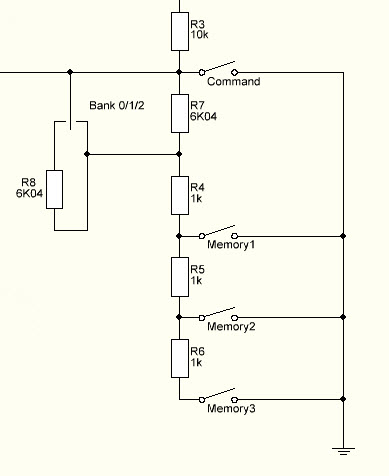
And this is my solution, below.


It's just a "shift" of the voltages read by the ADC; each position of the switch is "moving" the voltage with 3 memory places. 
Therefore, we have the same 3 banks but with no software hassle.
Just check to see if in the "keyer_settings.h" there are at least 10 buttons (1 COMMAND and 9 memory).


Basically, my solution is similar to what Dieter proposed but it uses the original code without rewrite the variables on the ADC array.

And gave no compile errors, of course.
73!

Most viewed posts in last 30 days