While I found some interesting facts about high impedance Un-Un transformers used on this type of antennas I felt the need to proper tune the wire but the "SWR" or "VNA" methods are not quite adequate, in my opinion.
Without making an in-depth theory, I will tell you why those two methods are not good for tuning EFHW antennas. By "tuning" I understand trimming the radiating element to transfer most of the energy from the transmitter into the 'air' a.k.a "RF radiation"...
But first, let's see (in short) what an EFHW antenna is?
We all know that an antenna, the radiating system, is made from two parts on which the RF current is fed.
Basically, it is a transducer that transforms the alternate current into electromagnetic radiation. Like any other type of electric circuit it need to be "closed" meaning the current has to be applied to apositive and a negative poles.
On the antennas, we might consider the "positive" one as being the radiator part and the "negative" the radial system or, like in the case of dipole antennas, the other wire.
The antennas might be symmetrical or assymetrical. in the first category we have the most simpler antennas, the dipoles. On assymetrical side, we might look at the vertical antennas or various types derived from dipoles, like theJ-poles or Zepp(elin) antennas.
Being a "radiating" system, the antenna must transfer most of the energy that is fed at the input and because we are talking about radio-frequency, we must match the impedance of the antenna with the impedance of the transmitter. Because the antenna transfer energy to and from 'the air" from and to the transceiver, matching them in the proper way will benefit for both transmitting and receiving the signal.
Antennas are bi-directional transducers...
What is "impedance"? Well, in direct current (DC), the load is pure resistive. Being a constant flow of electricity, the load will be just that, a pure resistor but in the presence of alternating current, the load will present also inductivity and capacitance due to mechanical features of the load.
Some components like chemical or pelicular resistors will exhibit a very little capacitive and inductive reactance other like coils will have big inductance and capacitors bigger capacitance (they also have a small resistivity which define the "leakage current").
Thus, an antenna will have a complex reactance; the laws of Physics say that if we want to transfer the most energy to the antenna, the capacitive or inductive part must be as low as we can achieve, best being zero.
"Reactance" is called like so for a good reason, inductive or capacitive part is "opposing" to the transfer of the energy to antenna by shifting the current regarding to the voltage resulting "reactive power" that goes warming the environment.
By choosing the correct dimensions of antennas, we can lower the reactive component of the impedance getting all the "juice" out of it. This is called "RESONANCE".
We can say that, at the resonance, the transfer of energy from the transmitter to the antenna is the best. The problem what arise here is that the antennas resonate at various impedances thus, the pure resistive part is not always 50 Ohm!
A short note: because SWR meters are made to measure the reflected power (derived from the complex impedance, resistive and reactive part), a 1:1 SWR is often achieved when the antenna is not perfectly matched.
A necessary note: the impedance of a perfectly cut dipole WILL still have a reactive component and this is due to the thickness of the wire. For the sake of this article, I deliberately choose to ignore this annoying things. Just for you to know that I am aware :-)
Example:
An open dipole perfectly tuned at the resonance frequency will have a resistive component of ...72 Ohm! Measuring the SWR will give a 1.5:1 reading and if we will search for a perfect 1:1 match, actually we will decrease the 72 (some say 75) Ohms resistive impedance to a 72-j22 Ohms. But this will add a reactive component which will translate into loss.
The things are pretty similar on vertical ground plane antenna which have the impedance at resonant frequency of 35+/-j0 Ohms. Same 1.5:1 SWR reading...
OK, enough with this, we are going into the rabbit hole!
What is End Fed Half Wave antenna (EFHW)?
Well, the best reference antenna is a symmetrical dipole, fed at the center, made by two wires each being a quarter wave lenght; it is a single frequency resonant antenna as i'ts said.
The voltage/current distribution on this antenna is a high current and a low voltage at it's feeding point>
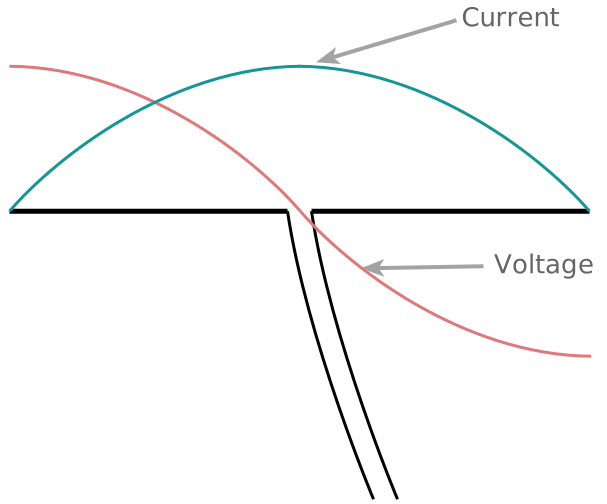
The 72 Ohms impedance is close enough to the 50 Ohms of the transceiver to not bother too much.
But this is a hard to deploy antenna in short field sessions so simpler antennas ar in use.
While "wonder" antennas can be very practical, when using low bands, the compact dimensions of those antennas make them pretty frustrating because of the losses; working QRP on 40m band with a 1.2m antenna is more like a punishment than a joy!
What if, we can combine the benefits of a half wave dipole in terms of efficiency with the ease of deploying a single wire, fed at one end?
Well, the antenna will resonate and transfer more energy than a short vertical or other type of compromising antenna, we will ease the deployment by giving the chance to use a tree to hang that wire and so on.
But there is a downside here; the theoretical impedance of this antenna is high, very high, up to 4000 Ohms, well away from the 50 Ohms required for a good match to the transceiver.
Because of the constraints in the mathematical model, the impedance is determined by practical observations and let's just say that those who pretend the antenna is a "monopole" are wrong because they neglect the common mode current which is there because the antennas need two part to work. Without "the other" part, there will be no current!
This is why a UnUn (Unbalanced to Unbalanced) transformer is needed. We need to lower the high impedance in range of 2-4 KOhms to match the 50 Ohms. So, a 49/1 will be in that range, a 2000 KOhms will give a 40 Ohms and a 5000 KOhm a 82 Ohms which will give us a 1.6:1 mismatch (at worst) for this kind of antenna. This is well between the limits that a transistorised final stage can cope with.
Because of the limitations of the theoretical model and some deviations introduced by the "to infinite" impedance at the end of the wire, were we feed the antenna and the common mode current that is inherent to this kind of antenna, it is hard to say that we really got the wire to resonance.
The usual advice when trimming this antennas is to make the UnUn then to connect the wire and trim it for the lowest SWR but this will measure a complex system made from: the wire, the UnUn and the coaxial cable. All of this are part of what we are trying to use as a "EFHW antenna".
But, remember? Our interest is to put most of the energy from the transmitter into the air so we need an objective mean to measure that!
There are two such means that get into my mind: a RF field measurement device and an RF Ammeter.
While using the first it is very complicated and it is used by serious manufacturers in special test fields, the second one is easy to make and accessible to any ham that know how to use a solder iron.
The distribution of the current in EFHW antenna call for a high voltage at the feeding point and a low current. When the current is at minimum, we know we have trimmed the wire well.
And here I came to the little sh*** I made yesterday afternoon...
Sorry I made you read so much before you got to the pictures, HI HI!

I is a simple RF Ammeter made with a ferrite clamp-on RFI supressor. They are usually made from Mix43.
A 10 turns Enamelled Copper wire (0.6mm diameter but can be thinner) coil between the ferrite half and the plastic support.

The transformer is glued with epoxidic resin to a small PCB.


This is the test wire I made to "calibrate" the readings for a 500mW on 50 Ohm full scale.
The tests show a constant reading between 1.8 MHz and 30 MHz. in the picture the PWR/SWR meter is not shown but it is in the circuit.

This is the modified coaxial wire I used to check the current into the dummy load.
Now, I can play with it and trim the wire for my EFHW antennas getting the most out of them. After trimming the wire for the lowest current, if a mismatch is shown on the SWR meter, next on line for trimming will be the UnUn. The "legend" say that a 49:1 ratio UnUn is the best but I am curios what the field testing findings will be!
After getting the proper ratio, any variations in the field deployment will be resolved by the ATU. Or not bother if they are within resonable limits.
We will see.
With this, I can also check for common mode currents into my shack.
After testing the concept, I made it to the final "product". A Peaktech uA was just right!


Cheers, de YO3HJV.
LE:
I made a second iteration of the final device, a more compact one for field use.
This one has two "sensors":
-a clamp-on RFI suppressor
-a Mix43 toroid with two BNC for situations were access to the actual radiator or radial is not possible.
I will put here only the pictures.
Some details:
-no more doubling voltage detection; just one diode and the resistor is 100 Ohms/1W.
-each detector has it's own voltage preset so I can calibrate differents scales for BNC and clamp-on circuit. Now they are calibrated for the same values: 5W and 50W for full scale indication,
-the micro-ammeter is, in fact, a 100 mA full scale indicator; it is less sensitive but not so delicate like the previous one and this was deliberate as to resist the portable op ordeal :-)
-the secondary winding has 12 turns instead of 10 for more voltage on detector.
A very interesting conclusion when I tested it both for voltages and frequency:
The clamp-on RFI choke and the Mix-43 toroid exhibits the same voltage output regarding to the power and frequency strongly suggesting that the material used for the RFI supprofessor IS, in deed, Mix-43 as I assumend based on the colour and texture.


