26 October 2013

Thinkpad Batteries. Myths and realities.

Searching for some specific problems related to Power Management - a bit of software from Lenovo, i was run into a lot of discussions about how bad batteries are...
Well, might be some true when we look at the "compatible" batteries market but also the user might be responsible for the bad performance.
Understanding the batteries is simple when one know the minimal set of rules.
It is not unusual that a "compatible" battery to perform oustanding, just like a branded one or some branded batteries to show "sudden death symptome.
There is no such a "timed bombe" circuit to force one to buy another battery!
I heard some guys trying to explain that inside the battery circuit is a controller which monitor the total number of the charge-discharge cycles and after a certain number the chip decide to kill the battery. Might be some truth around but, what is a "cycle"? When a charge-discharge count as a "cycle"? You see, it's not so simple!

The battery pack is more than some cells in series, parallel or mixed circuits.
Usually, there is a chip inside who monitors the voltage and the capacity of each cell pack (on extended packs, there are two cells in parallel) to decide if the pack is OK or not and also to measure the input and output capacity (gauge meter).
 That circuit need a reset from time to time to reestablish the relation between the voltage and the overall capacity. This is the "battery reset" or "gauge reset" procedure presented on some specific software.
A little paranthesis here: often I see that the preloaded software from the PC producer is considered "bloatware" and the user relies on the Windows's driver. Or the Linux's, if you like...
It's a major mistake as the producer of the hardware provided pieces of circuits to interact with that software in order to have a correct exploitation of the battery pack.
The battery pack also communicate with the computer at a very low level, BIOS controlled laguage, via a serial interface, usually I2C. The charger circuit inside the computer listen for specific information from the battery pack ad take decisions like charging, not charging or reject the battery due to some failure. Also the version of the software may have some bugs which determines erratic behavior.
It might be usefull to know that a Li chemistry battery does not like the 100% charging and a 95% limit can and will prolonge the battery life more over the "500 cycle" life! Not too many knows that iPads usually use around 90% from the overall capacity of the battery and this is one reason for the life of that devices. The other is Quality controll.
There might be a risk of  failure but: Use an up-to-date BIOS FW, use adequate and up-to-date drivers and software for Power management and set the limit of the charging at 90 - 95 % and you will have a happy battery! Another thing, Li chemistry does not like high temperatures so try to cool down the laptop by maintenance of the main fan. I have a T43 with a 2009 battery, a X61tablet with a 2011 battery and a X61 with a 2012 battery. All are extended, all are "compatible" not originals and all are over 85% of their factory capacity, except the T43 which is at about 74%. Well, as a matter of fact, the T43 was finally destroyed after more than 7 years of impecable service by my daughter and 1 L of water...

I'l post here some pictures from the T43's battery pack, made in 2009 and used till a few days ago, with more than 70% of nominal capacity.

You can see that there are 9 LiIon cells, 3 sets of three in parallel. This means 3 x 3,5V =  10.5 V nominal.
When full charge, the voltage is 3 x 4.2V = 12.6V and, by the same rationale, the discharge voltage is 9 V (3 V cutoff voltage per cell).


Also, inside the battery is a small PCB on which wee see the FET transistors and a small ATMEGA Microcontroller Unit (ATMEL MEGA406).


According to the datasheet:

 ATmega406 smart battery solution, the first single-chip implementation on the market. In a single die, the ATmega406 includes a powerful AVR MCU, a voltage regulator capable of being powered directly from the battery pack, analog to digital converters custom tailored for battery monitoring, high voltage charge and discharge FET drivers, cell balancing capabilities, and independent battery protection circuitry. This true one-chip solution saves design cost and PCB space in addition to broadening the functionality of the smart battery application. With the accuracy of the ATmega406, battery vendors will be able to predict the charge status of the battery more accurately. The better the knowledge of the battery cell, the more it can be allowed to be depleted before reaching the level where the cell itself starts to be damaged. This effectively increases actual battery capacity.

 Short said, it's a whole battery management system inside the battery pack!
Also there are rumors that the battery itself has the "knowledge" of the manufaturing date (indeed, this informations are programmed inside the MCU non-volatile memory) and also "know" when to kill the battery (usually, after the warranty expires) which, of course, it's false because, at least, ATmega 406, doesn't have a RTCC (Realt Time Calendar Calculator).

But stay! In the datasheet it says that:

The ATmega406 is fully in-field upgradeable through the Two Wire Interface (I2C compatible), making it possible to update it s software from the PC in which the battery pack is installed. The on-chip debug system has full access to all features on the chip, making it easy to do software development. 
You catch it? The battery firmware can be upgraded via the PC on which is connected! This may explain why the "bloatware" can do the job and the generic drivers cannot! Think about!


 Regards from Adrian, yo3hjv

30 September 2013

Experience put to work

http://synergybyte.blogspot.ro/

The time has come to change the hobby for a more professional way of doing things. Therefore, among with my buddy, Edi, YO3HCV, we started a little enterprise for professional projects dedicated for targeted high-end clients.
SynergyBYTE is the concept that describe our team.
It's an open team but don't call us, we will ask you to join us.


26 September 2013

TRBONET IPSC for Radioamateur DMR YO Net

Today is a great day! I manage to connect two DR3000 repeaters into a IPSC network. Well, I tried before but something seemed to be wrong as I didn't manage to hear a QSO from one repeater's frequency to another! Only after I put both repeaters under a router I had the IPSC running! Maybe this is a clue for other experimenters like me!

08 September 2013

Antena gonflabila pentru CUBESAT

Professor Sara Seager KB1WTW - Image credit MITO echipa de cercetatori de la MIT (Massachussets Institute for Technologies), condusa de  Alessandra Babuscia anunta dezvoltarea unui nou proiect de antena pentru microsateliti cunoscuti sub numele de CubeSat.
Datorita dimensiunilor mici, microsatelitii folosesc in prezent antene dipol sau monopol. Datorita dimensiunilor, aceste antene au castig relativ mic ceea ce restrictioneaza largimea de banda utilizabila pentru transmisia informatiilor catre statiile la sol; o antena cu castig mai mare ar permite cresterea acestei largimi de banda.
Professor Sara Seager KB1WTW – Image credit MIT


Echipa MIT, condusa de Alessandra Babuscia  este parte a unui grup de cercetare compus din radioamatori din care fac parte Profesorul Sara Seager KB1WTW, Mary Knapp KB1WUA, Benjamin Corbin, Mark Van de Loo - absolventi MIT,  si Rebecca Jensen-Clem de la California Institute of Technology.
Noul design conceput de echipa poate creste semnificativ distanta de comunicatie al acestor sateliti, permitandu-le chiar instalarea pe orbite mai inalte. Echipa a construit si testat antena care ocupa un spatiu restrans in satelit si se poate umfla odata ce acesta a ajuns pe orbita.
Echipa sustine ca distanta la care se poate comunica cu ajutorul acestei noi antene creste cu pana la 7 ori fata de distanta acoperita cu antenele CubeSat traditionale.
Alessandra Babuscia - Image Credit MIT
Alessandra Babuscia – Image Credit MIT
“Cu aceasta antena vor fi posibile comunicatii chiar de pe Luna”  sustine Alessandra Babuscia, care conduce acasta cercetare in cadrul studiilor postdoctorale la MIT. "Aceasta antena este cea mai ieftina si mai economica solutie la problema comunicatiilor" mai afirma cercetatoarea.

Pudra "magica"
O antena gonflabila nu este, de fapt, o idee noua. De fapt, experimente anterioare au demonstrat validitatea principiului pe sateliti mai mari. Sistemul insa necesita o serie de dispozitive specifice (valve de presiune, rezervoare de gaz) care ar ocupa un spatiu pretios in microsatelitii CubeSat. Babuscia ridica si o alta problema de ordin practic: un satelit cu dispozitive presurizate la bordul rachetei purtatoare poate pune probleme pentru securitatea incarcaturii, mai ales ca microsatelitii sunt, de regula, incarcatura secundara. Ei pot exploda, cu consecinte dezastruoase pentru echipaj si incarcatura principala.
Din acest motiv, s-a cautat o alta metoda pentru umflarea acestor antene.

Mary Knapp KB1WUA - Image credit Interplanetary Small Satellite Conference
Mary Knapp KB1WUA – Image credit Interplanetary Small Satellite Conference

Echipa de cercetare a gasit o alta metoda constand in sublimarea la presiune zero a unei pulberi . Aceasta inseamna ca o pulbere, expusa presiunii din spatiul cosmic se va transforma, din stare solida, direct in gaz.

Testarea ideei
Babuscia si colegii sai au construit doua astfel de antene, folosind Mylar: una in forma conica si a doua in forma cilindrica. Au determinat configuratia optima la pliere si au reusit sa inghesui aceasta antena intr-un spatiu de 10cmc.
Au testat apoi modul in care antena se umfla, intr-o camera vidata iar testul a avut rezultate pozitive.
Rebecca Jensen-Clem - Image credit Interplanetary Small Satellite Conference
Rebecca Jensen-Clem – Image credit Interplanetary Small Satellite Conference
Echipa a testat apoi caracteristicile  electromagnetice ale acestei antene. In simularile celor doua geometrii, s-a constatat ca antena de forma cilindrica se comporta mai bine decat cea conica.
Desi, cu potential major, antena din Mylar subtire poate fi vulnerabila la fragmentele meteoritice sau chiar la deseurile care pot fi intalnite pe orbitele joase; una din solutiile pentru a compensa micile perforatii ar fi o rezerva suplimentara de pulbere care sa compenseze pierderile de presiune din antena.

MIT student with a CubeSat - Image credit MIT
MIT student with a CubeSat – Image credit MIT

Kar-Ming Cheung, inginer la Laboratorul de Propulsie Reactiva de la NASA (JPL), specializat in comunicatiile spatiale a afirmat ca o antena directionala a fost, pana acum, in afara discutiei referitoare microsateliti si ca "aceasta idee este foarte promitatoare".


Students build a 3U CubeSat - Image Credit NASA
Students build a 3U CubeSat – Image Credit NASA

Traducere si adaptare, Adrian, YO3HJV. 
Articolul original: http://amsat-uk.org/2013/09/07/inflatable-antenna-could-give-cubesats-greater-reach/

Hamradio contesting - a menace to hamspirit

Well, some will say that i am wrong only by reading the title...
As a foreword, it is not my intention to blame contesters.
I am in my early 40 and have a busy job, some other particular projects and can operate my radio in weekends.
I do not have, yet, established a "big-gun" station; only 100 W from a FT2k, a vertical and a Inverted V antenna on the rooftop of my building.
I also have some familly obligations here so I cannot stand in front of my radio to make QSOs in weekdays.
The only time I have for chatting is in the weekends, even in holydays BUT...
Yeah, you already know!
Try to search a weekend WITHOUT a contest!
As a practical observation, not a single weekend for old fashion hamradio QSO in this summer! Everytime I powered up the radio, there was a contest. thousand of Watts, QRM from "Russian QRP" and all you can hear are contest exchanges and the ubiquitous "599".
Is this hamradio? I think is not!
The regulations - at least in YO - ask for operators to send a REAL REPORT in the QSO's. I don't know how, but in the contests I NEVER heard a REAL REPORT based on Strenght, Rediability and Tone!
We, the OM, teach the younger how to sent a receiving report in a QSO. The contest means that the contesters are tested about the capacity to copy signals, to wrote the (correct) informations in a LOG and to sent back some (correct) informations AND to make a certain number of QSO's in the contest time..
Instead, the contest become more and more a speed run.
I am bored of local QSO's about weather and cristal sets; I want to discuss with other hams about Emergency comms, about how their local clubs manage to keep the team, about new technology.
Well, it is almost impossible to do so in weekends on shortwave!
Try this on a contest!
The progress in hamradio, at least in the last years, means big antennas and QRO mainly for the contest activity.
It is almost impossible to chat with a fellow ham about new receving techniques, about new modulations or something like that!
The ham bands was established also for experimenting but, at least on IARU bands, you hardly find a non-contesting segment to do some tests with a faint signal station... Spletters and QRM.
So, more and more, the experimenting activity moved to internet discussion groups which, in my opinion means death to real hamspirit! The contesting is only a fraction of that!

73 de YO3HJV.


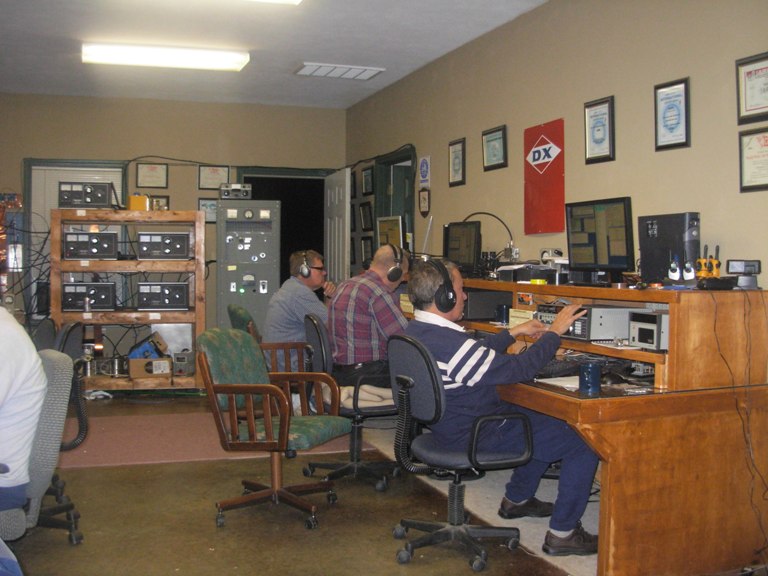
The picture is courtesy of http://k5go.com/

Most viewed posts in last 30 days