27 June 2010

Calculator pentru radioamatori

Am reusit sa transpun in WEB tabelul calculator in xls pe care il foloseam de destul de multa vreme pentru totr felul de calcule.
Va recomand sa apelati la el ori de cate ori aveti dubii cu privire la posibilitatea de stabilire a unui canal radio intre doua statii sau atunci cand nu mai stici cati dBm reprezinta 1W.

Sper sa il gasiti util si sa il folositi cu placere!

Pentru a-l utiliza, click pe imagine!


11 June 2010

The biggest YOFF Expedition /MM is about to start!

ExpeditionA few fellow hams will start what it will be "The biggest YOFF Event in Romania", a /MM trip on the Danube Delta!

They will be active mostly in HF bands and will have a QRO (500 W) in order to be heard by a grossly mass of DX hunters.

So be prepared or YOFF-021 !


10 June 2010

Condenser mic for TS-2000


A found a very nice schematics for connecting a condenser microphone with the Kenwood TS-2000. It is especially usefull for users that want to use combo mic-headset with their beloved transceiver!


Original drawing from UU2JJ

17 May 2010

Field Programming for Kenwood TK-370

The Kenwood TK-370 is a versatile 32 channel portable radio, capable to deliver up to 5W in UHF from 380 MHz up to 500 MHz. Of course, with some tuning in the front end receiving section...
You can use KPG-27D software (DOS based) or you can choose the easy way for programming from the keyboard.

Here is the algorithm for keyboard programming:

To enter in the programming sequence, press and hold (light) & (dial) while turning on radio.

Hold until (SEL) appears on the display.

You can choose three sets of menu items, depending on what key is pressed after entering into programming mode.
To advance in the menu items, press PTT. At the end of the menu commands set, will be shown on the LCD.

Pressing (SCN) allows you to program the following

1. Monitor Key
Off = off
1 = Monitor momentary
2 = Monitor Lock
3 = Squelch off momentary

2. Scan Key
Off = off
Co = carrier operate
To = Time operate

3. Dial Key
Off = off
On = enable

4. TA key
TA = talkaround
RV = Reverse
Off

5. Lo Key
On
Off

6. Priority
None
1 = fixed
2 = selected

7. Fixed Priority Channel
Turn selector to channel

8. Look back time A
Turn selector to time in seconds

9. Look back time B
Turn selector to time in seconds

10. Revert Channel
1 = Selected
2 = Last Call
3 = Last used
4 = Selected + Talkback
5 = Priority
6 = Priority + Talkback

11. Tx Dwell time
Turn selector to time in seconds

12. Drop out delay
Turn selector to time in seconds

13. Time out timer
Turn selector to time in seconds

14. Tot Pre-alert
Turn selector to time in seconds

15. Tot Rekey time
Turn selector to time in seconds

16. Tot reset time
Turn selector to time in seconds

17. Squelch Level
Turn selector to Squelch

18. Beep tone
On
Off

19. Signalling
And
Or

20. Battery Save
On
Off

21. Selectable QT
On
Off

22. Clr to transpond
On
Off

23. Del/ Add
On
Off

Pressing (Dial) allows programming of:

DTMF

24. digit time
Turn selector to time in milliseconds

25. inter digit time
Turn selector to time in milliseconds

26. First digit time
Turn selector to time in milliseconds

27. Rise time
Turn selector to time in milliseconds

28. Rise time with QT
Turn selector to time in milliseconds

29. PTT ID
Off
1 = connect
2 = disconnect
3 = Both

30. Dial ID
On
Off

31. Connect ID

32. Disconnect ID

33. # of DTMF keys on Keypad
12
16

34. DTMF hold time
On
Off

35. Store & send
On
Off

36. D key assignment
Turn selector to D or time in seconds for pause

37. Dtmf Signaling
Off
1 = code squelch
2 = Selective Call

38. Intermediate Code
OFF
A
B
C
D
E
F

39. Group Code
OFF
A
B
C
D
E
F

40. Auto Reset time
Turn selector for time in Seconds
41. Call Alert/ Transpond
Off
1 =
2 =
3
4
5

42. Transpond
On
Off

Pressing (TA) will allow you to program Frequencies

Use selector to choose channel
Press PTT

Enter Rx frequency using:
- the Selector Knob to change kHz;
- the Selector Knob + (light) to change MHz.

If no channel is Shown press the (LO) button.
Press PTT

Enter Rx CTCSS code
Press PTT

Enter Tx Frequency as above
Press PTT

Enter Tx CTCSS code
Press PTT

1. Option Signal
Off
1 = DTMF
2 = 2-Tone

2. PTT ID
On
Off

3. Add/ Del

4. Busy Tx

5. Clock frequency shift

6. Power
Hi
Low

19 April 2010

Portable holiday setup

Acum aproape o luna am primit de la Corrado o antena Sirio Megawatt DX4000.
De la "mama ei", antena este destinata utilizarii pe masina in canalele CB.

Este cea mai lunga antena de mobil pe care am intalnit-o in Romania. Poate mai sunt pe alte meleaguri...
Potrivit specificatiilor, antena suporta 600W continuu; este terminata in mufa UHF (nu sunt un fan al acestei mufe dar este relativ OK in HF) si are, atentie, 2 m inaltime!
Am avut ocazia sa trag cu ochiul la un prospect Sirio unde este prezentata in sectiune zona bobinei. Astfel am vazut ca bobina este doar in prelungirea spicului nefiind conectata si la masa. Acest aspect a fost confirmat si cu aparatul de masura. Destul de fireasca solutia, intrucat, la aceasta lungime, cateva spire fac antena sa simuleze un GP sfert de unda (aproximativ 2,6m fizic).
Ideea este ca antena a fost "tintita" pentru utilizare in benzile HF, nu numai in banda de 28 MHz ( in care merge ireprosabil scoasa din tipla!).
Antena este insotita de montura de fixare pe tabla capotei, la o stfel de lungime nefiind recomandabila utilizarea suporturilor magnetice; montura este insotita si de un cablu RG58U terminat cu mufa DV la capatul dinspre antena si cu mufa UHF tata la capatul dinspre statie.

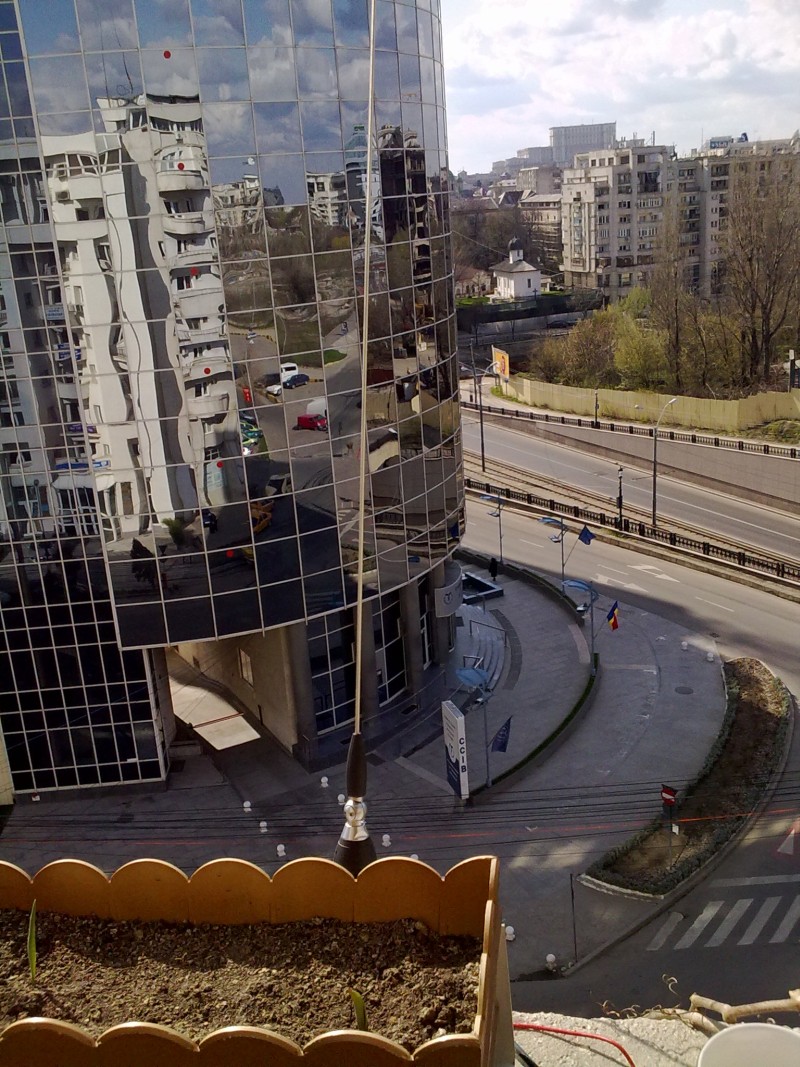
Fixarea pentru teste am facut-o pe marginea balconului, pe o piesa L din otel, la randul ei fixata cu suruburi de o platbanda de Al pentru imobilizarea pe balustrada balconului.
A fost necesara inclinarea antenei pentru a o scoate de sub plafonul balconului.
Ca de obicei la astfel de teste, am fixat si o contragreutate realizata dintr-un banal fir electric multifilar, din Cu izolat cu PVC in lungime de aproximativ 3m, lasat sa atarne sub antena.
Pentru teste am utilizat:
A. FT817N+LDG Z817
B. FT857D+LDG Z100.
Antena se acordeaza absolut superb in benzile de 30m, 20m, 17m, 15m, 12m, 10m si 6m. Din pacate, propagarea nu a fost deschisa in benzile de la 12 m in sus, astfel ca probele s-au concretizat in legaturi in benzile inferioare valorii de 12m.

In varianta A am realizat legaturi in D, UR si GB in gama 20m-17m.
In varianta B, am avut placuta surpriza sa lucrez si W precum si o statie din PY!.

Folosind un dispozitiv de adaptare a antenei (un UnUn cu comutator 4:1 sau 9:1 si cu o bobina cu prize comutabile), am adaptat antena si pentru lucrul in benzile de 40m si 80m, conectand unitatea AM (antenna matcher) cu un cablu scurt cu un mic crocodil direct la mufa DV.
In banda de 40m am facut legaturi in Europa fara nici un fel de probleme, cu ambele variante de test.
In banda de 80m, am auzit statiile YO "traditionale" (YO2LGX, YO5PDW s.a.m.d) dar nu am fost auzit. Poate si pentru ca antena era cam prea sus pentru exploatarea efectului NVIS.
Una peste alta, antena se preteaza la operarea in regim portabil. Singura problema reala pe care o pune aceasta antena este transportul; in cazul in care deplasarea se face cu un autoturism, poate servi bine-mersi pentru echiparea statiei CB.
Totusi, retineti: este prea lunga pentru suportul magnetic!
Antena urmeaza sa echipeze Unitatea Mobila de Comunicatii a Societatii Romane a Radioamatorilor, in trusa de echipamente portabile HF.

Most viewed posts in last 30 days